

It is not often that I leave this class thinking more about the warm-up than the actual class interaction, but, I couldn’t get Ranganathan’s five laws out of my head. Maybe it’s because I now have words to describe beliefs I’ve always had. Maybe it’s because the discussion that came out of it was truly interesting. Or, maybe it’s because I’m going to have to track down that 500 page book and take in the knowledge in all that extra free time I don’t actually have. In any of these cases, I just feel, someway, that I am not quite done with these laws. So, I want to address them a little more thoroughly here.
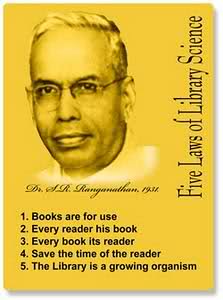
Books are for Use
While this just seems obvious, even as early as the writing in 1931, the importance of making the statement just rings true. No book was ever written without a purpose, and, denying that purpose denies the importance of what books truly mean to the world. Literature is at the forefront of education. Whether you are a student striving for knowledge or a patron seeking entertainment, every book has a purpose and that purpose changes from person to person. While I pride myself on the small collection of varying volumes I have collected over the years, the fact that most of them reside in boxes due to lack of space seems like an injustice. Neatly packed away, awaiting the day to grace the shelf again, leads to an inaccessibility that denies a book its purpose. In more than one instance through the years, I have ravenously searched through these boxes in attempts to find a particular quote from a particular book that has only fleeted through my head. This travesty of storing books out of sight also makes the sharing of the knowledge within the books almost impossible, as, if I want to suggest a reading to someone, and I know I have the volume myself, it is extremely difficult to provide the physical copy of the reference I make.
Every Reader his/her book : Every Book its Reader
While I understand the separation of these two laws, in understanding them, they meld into one for me. The reflection of a book on its reader and the readers reflection on a book are essential to understanding what makes up a full person, or, at least a person that is a reader. From books that entertain to literature that educates, every piece every consumed by a person places a new piece into the jigsaw that creates the entirety of that reader. Some books of entertainment have shaped me far more than the academic volumes I’ve consumed in my past. I reference many things back to literature. Childhood memories of immersing myself into J.K. Rowling’s Harry Potter series comes to mind just as quickly as the first time I read Emily Yellin’s Our Mother’s War and truly understood the part women played in all aspects of World War II, from military to baseball. These placed important aspects of myself into my greater being and shaped the ideas and values I still carry with me. Understanding these reflections also speaks to why I reference literature whenever I can, as it grounds me in the world I know, and sharing the knowledge of a book, or the book itself, shares a piece of my identity with someone. The understanding of both these laws, from the perspective of librarian, could go further to solidify the neutrality that the ALA claims to strive for in attending to patrons. If the reader is a reflection of a book and the book is the reflection of the reader, how can we deny the information that can be garnered by such a truly important interaction?
Save the Time of the Reader
This law can be applied to both organization and education. In organization, as the law was intended, libraries should attempt to decrease their intimidation factor. Humans, by nature, seek an organized way of living. Categorical beings, being able to understand organizational structures is of the utmost importance to encourage use. With proper organization, readers perceive better access, though the conversation about this organization is constantly in flux as the library evolves. These ideas build on the concepts of readers as students as well. The more one knows about the foundation of a subject, the less time they have to spend in building new knowledge on the understanding of foundational knowledge. For example, understanding the foundations of history allows for the building of new historical knowledge on the foundations of what is already known, saving a reader time as they become more familiar with topics. A proper organizational scheme in libraries also fosters this type of knowledge accumulation and time saving.
The Library is a Growing Organism
If the library did not grow, its purpose could not be understood. The focus of research in the library speaks to this. To help accentuate the importance of the library, to the reader and to the nonreader (though, the nonreader just seems like a sad state of being), research into libraries fosters the ability to emphasize the value libraries on their own hold. If libraries are responsible for the accumulation of knowledge and the shaping of world views, their influence on the people it serves, in and of itself, shows growth as an organism. As people that have been touched by these institutions grow, converse, and act in the world, the library grows with it. Then, to continue to serve new readers and current readers, the institution itself, must grow, bringing in new physical (and now digital) resources to serve the needs of new, current, and potential users to spread its influence and quench a thirst for knowledge. Just as the book lives within us, once a reader has consumed it, the library also lives within us, once it has served our information needs just once. Bringing that influence with us into the world, as readers, we help the library to grow.

 Raven K
I also enjoyed the discussion of Ranganathan’s five laws. I’d sometimes found them cryptic, and other times unhelpful. Every book its reader? No, some of them need to be weeded. Of course, their brevity is probably what makes them meaningful and adaptable to changing times. I had no idea they were excerpted from a 500-page book, which I should probably look at for context the next time I feel frustrated by them. The full text is available in HathiTrust!
LikeLiked by 1 person
I love your analogy to books being pieces in a jigsaw puzzle that make up the entirety of a reader! What beautiful imagery. Your reference to Harry Potter brings up vividly how much it influenced my imagination as a child, creating an immersive world that sheltered me when I went through some rough times.
Additionally, your discussion of books being for use and the fact that you have many books packed away captured my attention. That and the discussion in class reminded me of the Marie Kontaro book “The Life-changing Magic of Tidying Up.” In organizing and minimizing clutter, she encourages people to save only things that have a clear practical use or that “spark joy.” For me, books can do both of those things, but some books I realized I was never going to read again, so it made sense to pass them on through donation to allow others to get use out of them. I hope you can figure out the best way for your books in boxes to get use!
LikeLiked by 1 person