

(Title comes from Raganathan’s The Five Laws of Library Science page 306.)
The Third Law of Library Science is depicted as “EVERY BOOK ITS READER” (Raganathan, 299). Slowly, the repetition of these ideas has increased throughout the book. While the First Law appeared approximately 1.4 times a page, the Third Law has increased to appearing about 1.5 times a page, with the “Third Law of Library Science” and its iterations appearing 47 times throughout the 36 pages, and the repetition of the law itself appearing just 8 times. The focus of the law was quickly summed up in the introduction of the chapter though, as “the Third Law would urge that an appropriate reader should be found for every book” (Raganathan, 299).
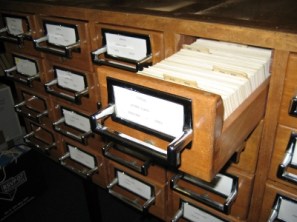 While this concept is not always clear of meaning, Raganathan used this short chapter to address the eight main ideas he felt played into the ability of the Third Law being achieved. First, he looked into how the library could provide better service to the reader, through open access, shelf arrangement, catalogues, and reference. In the second part of the chapter, he focused on the aspects that people associated with the library could focus on: popular departments, publicity, extension work, and book selection.
The largest argument that Raganathan made in this chapter was a call to the death of  closed stacks. His belief in the open access system stems from the idea that closed stacks are not just harmful to readers, but to the books that serve them. Essentially, the urging of browsing stacks was believed to help more books find their readers, in a way that closed stacks could never cater to the population. This is also why he found shelf-arrangement to be important. Not only did Raganathan argue that books should be arranged by subject-matter (which is the basis of the arranging system he founded), but that there were proper shelf dimensions to optimize reader’s browsing
  abilities, and that displays of books could be important for allowing patrons to know what is in a library. The appropriate utilization of cross-reference also provides the same types of important tools for readers to find their perfect books. Finally, Raganathan concludes that, even with all the other tools properly placed, the reference staff is essential for getting books properly circulated to the readers who can best use them. The reference staff provides the personal service libraries cannot do without to understand readers.
The importance of reference turns the focus of the chapter to what libraries can do to provide better patronage, so books can find their readers. The main goal in optimizing library use is to turn potential readers into actual readers (Raganathan, 314). In this way, Raganathan suggested the use of popular departments, such as News or Magazine Rooms, to lure people in. Once in the library, staff could begin cultivating personal connections to try and interest them in the book collection of the institution. Of course, to

do this, people would need to know of libraries, and, therefore, no form of publicity should be overlooked. Raganathan states “the simplest and the least expensive method of publicity is direct personal talk” (Raganathan, 324). The development of extension work to encourage new patrons is also important. Creating work beyond the library system of book circulation brings in new people, and staff can help them cultivate an interest in reading. “The object of extension work may be said to be an attempt to turn the library into a social centre whose function is the encouragement of reading,” which is why early extension work sometimes introduced itself in the ways of providing reading hours (for both children and illiterate adults), reading workshops, and other activities that would show patrons the importance of books in their daily lives (Raganathan, 327). Finally, he concludes that the development of collections should be an ongoing process in libraries, as the consideration of readers should always be a priority.
By approaching each of these things, the Third Law of Library Science can be achieved. Still, to be able to fully commit to the Third Law, the First Law and Second Law must already be in place, because if books are not used, and not all people have access to books, not all books will find their readers. The types of programs that Raganathan speaks to are clear in many forms throughout modern-day libraries as well. The types of expectations may have changed, but libraries still provide extension work like story hours and community spaces for learning (like Michigan Makers).
Interesting to note, in the discussion of extension work, Raganathan discusses how libraries can be used as a meeting place for community groups. He gives specific examples of groups that meet at British Libraries. In this discussion, he mentions the Workers’ Educational Association explicitly (Raganathan, 331). I found this interesting as he spoke at length of the Seafarer’s Educational Service in his lengthy approach to the Second Law of Library Science. These organizations were both founded by the same man, who was a champion of adult education in England.

 Raven K
It sounds like Raganathan had users’ experience a lot on his mind when he was writing these laws and shelf arrangements of books! It’s interesting to hear the history that some of the practices of libraries today perhaps originates from. I wonder if Raganathan was one of the first people to think about user experience in libraries and shift the focus of libraries and the kinds of services they provide? Also, that’s awesome that you’re actually reading his 500+ paged book! (On a side note, I found an infographic of Raganathan’s laws on a USC website that Wikipedia cited and thought you might find interesting: http://librarysciencedegree.usc.edu/resources/infographics/dr-s-r-ranganathans-five-laws-of-library-science/).
LikeLiked by 1 person
Really interesting infographic! Thanks!
LikeLiked by 1 person
I am struck by how salient many Ranganathan’s ideas are to not just libraries, but to business even in our era. One important area of focus in retail is the idea of converting potential customers into actual customers. In other words, if someone walks in the door of your store, you need to do whatever possible to make a sale and not have them walk out without making a purchase. Your mention of Ranganathan encouraging librarians to turn potential readers into actual readers reminds me of this. Additionally, he mentions that direct personal talk as the simplest and cheapest form of publicity; even today, word of mouth is a popular form of free “advertising” that can contribute greatly to the success of a business. Today, however, word of mouth is amplified by social media review platforms such as Yelp and Google reviews.
As an aside, I was excited to see your inclusion of the photo/article on drag queen story time. I remember a friend of mine in Chicago taking her small child to a similar event and posting photos on Facebook :).
LikeLike