
One of the most important things when coming to a new country is truly embracing the culture and the things it has to offer. I think it is even more critical when you are working in that country as well. While I have been trying to take advantage of my weekends here for this purpose (and not JUST to do tourist like things), my mentor has also been keen to make sure I get a full experience of the cultural aspects here in the Czech Republic. Originally she had assigned a colleague to help develop a “cultural curriculum” in a sense, to show me around the city, hit on historically significant sites, and answer any cultural question I may have. Of course, as sometimes happen, this did not work out and she has been working to make sure I do not lose that aspect.
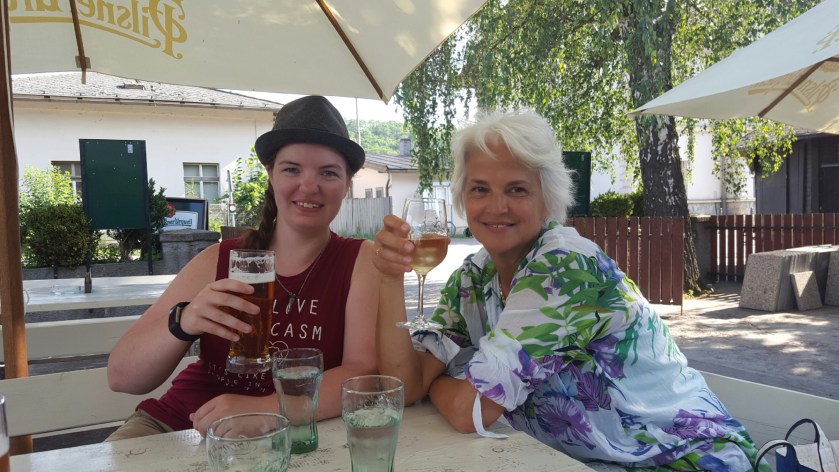
The last few weeks, my mentor has been hosting a friend she met in the United States who just recently returned  to her birth country of Italy. Cinzia is a fiery Italian-American New Yorker who moved to the U.S. in the late 1990s and became a teacher once she settled in New York. We met soon after she made it to Prague and had lovely conversations about our experiences with the world. Taking advantage of this connection, Stephanie suggested two days of experiences together. Wednesday we went to the Praha Zoo together, going into the heart of the city, taking
 a boat up the river, and experiencing a day among the animals. On Thursday, Stephanie joined us on an adventure outside of Praha to a fourteenth century castle, Karlstejn. While neither of us can provide explicit information about these things, having someone to take them in with made them that much more exceptional. While I had spoken with Cinzia prior to these two days, I think that our time together on these trips solidified a friendship that I truly hope continues as we walk through life on our different paths.
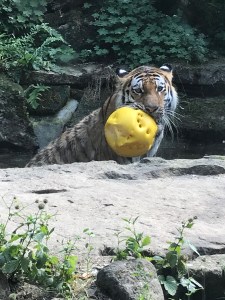
The Praha Zoo, to my surprise, was not really a tourist destination, which means, I got to experience a rare part of  Czech culture that I don’t think many would think of. Unlike in the U.S., this zoo houses both land and sea animals, combining the ideas of American zoos and aquariums. It is on the outskirts of the city and is a vast amount of land dedicated to animals, plants, and experiences. We spent about four hours at the zoo and didn’t even make it through half of it. The place is meant truly for the Czech people though. In my opinion, the layout and the exhibits highlight
  how these people understand and respect the life of animals. In no place in the United States would you find so much land dedicated just to them. The zoo was also a place for family. When we first arrived, we passed many mothers with their children, stopping and watching the animals, talking to their young boys and girls about them. Then, as the day went on, full families became much more the norm. We were out of place in our time at the zoo not because we were Americans, but because it definitely seemed to be a place of family education.
Throughout our time Wednesday, our conversation rarely waned. We discussed all sorts of topics, such as ending up on paths you never imagined before. Cinzia taught me things about the furrier trade and I told her some of the things I knew about the animals we came across. We talked on our experiences in the U.S. and our travels. We talked on the difficulties of translation and how cultures sometimes make it difficult to adjust, as “normal” changes from place to place. All-in-all, it was a day of good company and conversation paired with a unique experience in a piece of Czech culture.
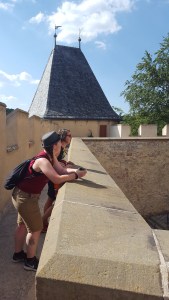
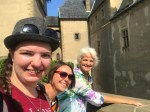 Thursday was just as pleasant. Meeting at the train station, we headed out of Praha with Stephanie telling us some things about the places we passed. Upon arrival, we walked from the train station to a small Greek restaurant and further discussed the castle we were getting ready to see. Karlstejn was built in 1348 and the village beneath it was renamed to be the same as the castle. It was used through the seventeenth century and was renovated in the nineteenth century to a likeness of its original glory. Now, of course, it is largely a tourist attraction. In the fourteenth century, Charles IV resided there and, for a time, the Crown Jewels were housed in the fortress. Like many fortifications, Karlstejn sits at a high elevation for strategic purposes.
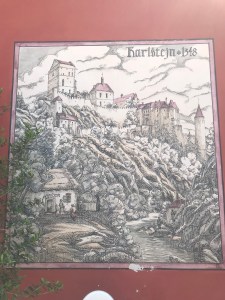
Our climb to the castle was filled with pleasant conversation and several stops. We took the short, 60 minute tour, instead of the longer 90 minute one. While our tour guide was not the most enthusiastic, the information we received led to more pleasant conversation after the tour. Many of the items in the castle are not original, but the stories and myths that surround them are interesting. The thing is that the facts and myths were not clearly separated by the
  guide, which sometimes made it difficult to tell what she was telling us actually happened and what was pure conjecture. Her perceived lack of interest, at least by us, did not help this issue. Though, every tour guide is different, which leads to varying experiences. I would definitely recommend the tour, if nothing else, just to see inside the castle and its inner grounds.

A late return to the city left us quite exhausted, but in all the good ways. The Czech people are a proud people of their history, whether it is medieval history or celebrating the First Republic. Getting to experience these things is truly something to understanding how the Czech people have gotten where they are now in the twenty-first century.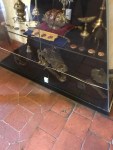 Charles IV, for example, holds a name in the capital as well. It isn’t just his residence from Karlstejn, but you see him everywhere, from Charles Bridge to Charles University and his final resting place at St. Vitus Cathedral within Prague Castle. These historical outings have led to some interesting conversations with my Czech colleagues about their understanding of their history as well, and I can’t wait to keep learning in this way.

 Raven K