
One of the reasons I feel that I fit in so well in the academic world, whether it be in research or in the world of libraries, is my consistent thirst for knowledge and to learn the unknown. This general curiosity usually fuels my travels as well, and was something that was cultivated well by my mentor this summer in Prague. Early in my internship, Stephanie even went so far as to send me toward a history talk in the city. This led to my first real exploration around Prague Castle, getting lost around the castle, and listening to a fascinating discussion on Jewish Escape Networks in Prague during World War II.
Stephanie, my mentor, knew of my background in history and my interest in learning more about how the Czech Republic fit into the overall narrative. She also was aware of my interest in World War II history, as we had discussed my previous research focus in school (the All American Girls Professional Baseball League, which played throughout World War II in the United States) and my experience in other countries around the Czech Republic where I continued to study World War II from the Eastern Front (Ukraine and Poland). Therefore, when she learned of this talk, she sent me on my way, with a comment that she would join me if she hadn’t had some things she needed to finish at the library.
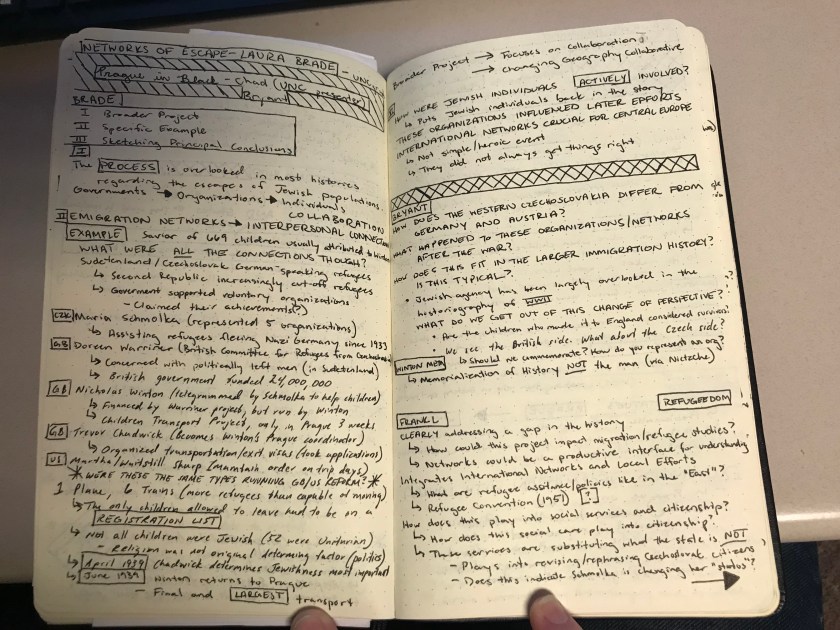
This talk led to my introduction to the historian Laura Brade, a recent graduate of the University of North Carolina-Chapel Hill and a faculty member at Albion College in Michigan. Her research had led her to spend time working in Prague and exploring how the Jewish population worked in the Czech Republic once they fell under Nazi rule in 1939. With the knowledge that Prague itself lost approximately 97% of its Jewish population during the war years, this talk was engaging, heart wrenching, and amazing all at the same time.
The talk led me to names I had not known before, including the story of a Czech woman I wish we had learned about during my studies of World War II history: Maria Schmolka. She had a hand in helping refugees flee Germany since the Nazis came to power in 1933. Brade talked about these stories and emphasized how these networks were created through a collaboration of emmigration networks already established and interpersonal relationships. She went on to talk about how this process is often overlooked in most histories, which I personally agreed with having known very little about such networks beyond small initiatives by individuals. One of the things I found incredibly refreshing, though, was her discussion on how heroes and heroines such as Schmolka, a Czech native, is often overlooked by the concerted efforts of more prominent organizations and religious groups, such as the American and British groups that worked in the area at the time. She talked of these “good will” missions which often would not have been possible without the efforts of people like Schmolka, who are often lost to history.

I found the entire talk extremely engaging and I have noticed that it has colored some of my readings into the subject since this time. Even as an academic, I have always found myself a little hesitant to engage with others about their talks though. I did make an effort to talk with Dr. Brade after her presentation though. After a long discussion with questions I had about her work, we had hoped to see each other again before she left the country, but this did not work out. Still, I looked up her other work in the field and have definitely kept an eye open for other works in this field. In fact, I kept these very ideas in mind when I recently read Eichmann in Jerusalem: A Report on the Banality of Evil by Hannah Arendt, who addressed these types of networks throughout her book.

 Raven K