Blog Post 9: Reflection on Week 8 Class and Week 9 Readings

I really appreciated the discussions that were fostered in each of our book clubs and the unique perspectives that came out as we all talked about how reading selections affected us differently. This led to some missteps in speaking that, I feel, were capable of being navigated better because of the intimate setting we were in compared to the reaction we may have gotten in a larger group. I know, for me personally, there was a reading where I really didn’t understand the  content being discussed because it isn’t a medium that I used, but I was capable of using my experience as an individual to understand the issue being talked about. I connected back to things that were common knowledge to me that I often don’t think of as not being something that most people are unaware of. When this was pointed out to me in discussion, it really made me stop and think, but because our moderators were prepared for open discussion, I was capable of navigating these comments in a way I don’t think would have been nearly as easy in a larger group.

I chose the Nonprofit and SAA codes of ethics because the other organization I was interested in (the ALA) I had read before. These were quite comparable to this previous reading though. The nonprofit reading provided a brief overview of how such organizations may adopt their own, unique codes of ethics, as they should consider their place as a nonprofit and in the context of the work they were doing. The SAA code, I feel, represented many of the same things that the ALA code does. Keeping in mind the expectations and foundations of archives and libraries, each of these codes of ethics creates guidelines that will uphold these beliefs.

In the examples I read for class, both explicitly stated that the codes of ethics were sets of guidelines. While individual organizations may expect people to act under them, there is no governing entity to make anyone follow the principles set forth in each of these documents. Still, reading them makes them seem like common sense. If you are an archivist, for example, and you have chosen that profession because it is something you care about, why would you risk the integrity of maintaining collections by turning away material that fits into your organization’s mission due to some beliefs you as an individual may have? I think the codes of ethics are a way to remind people that, within an organization, it is the organization and not the individual that should be guiding decisions that further the integrity of the group one works for. Of course, I think that such documents also make it possible to uphold decisions that go against detrimental practices that may be harmful to the integrity of the profession.

Blog Post 8: Reflection on Week 7 Class

Class discussion focused on how to best build a book club setting and concluded with an experiment in the Socratic Seminar setting. While I think that our small group discussions could have been extremely beneficial if all of us had read different articles, my first group all read the same readings for the week. This led to a consensus about how Socratic Seminars are constructed and what those guidelines might look like, but we did not have a good discussion on how those ideas might contrast with book clubs until we merged into larger groups. I think that this took a bit from the understanding we could have reached due to the lack of cohesion I think the small groups of two or three allow over the slightly larger groups. Still, I found the entire exercise helpful in working out some of the thoughts and ideas I had had in my own reading experience.

The group discussion culminated into a discussion of what all of our thoughts yielded into a group document. Comparing that to a previous year’s ideas, I found, was helpful to see how different groups of people understand these instances of learning differently. This was also a good way to introduce how to build the types of questions that may be asked in these settings. With the use of examples, these ideas were further enhanced.

I found the exercise of the Socratic Seminar to be the most useful though, as it provided an example of what our projects could result in. As an observer, I found it interesting to see how the inner circle interacted with one another. It also provided me with even more ideas that both supported the thoughts I had on the reading and contrasted with some of the things I noted. These observations were extremely helpful, I feel, for understanding the reading on an even higher level.

Blog Post 7: Reflection on Week 6 Class and on Week 7 Readings

I think the increase of group discussions and seminar-like courses have really enhanced my learning experiences throughout my years in university because they foster discussions that make you think about how you interpret material compared to how others with different experiences do. That is why I found this class so helpful in helping me to understand how different approaches to group discussions can have different effects on the outcomes. With the LEO exercise, I found it helpful to see that I mostly aligned in thinking with most of the people that shared the objective I had had, but I found it more helpful to understand the reading from the various perspectives of our jigsaw group. One of the points that our group made was that by approaching a text in this way, we were forced to think in a different way, due to the objective of our LEO, which led to some interesting revelations, but discussions with others that had gone through similar ways of thinking for various objectives provided even more perspectives for us to think about. These varying roles led to open discussions not only about the text but about the approach to these perspectives and the issues that some had with them because of how they think as individuals.

I think that these small groups prior to large class discussions also allow for more voices to be heard because we are more comfortable working out our confusions in smaller groups which can give us confidence to speak to the group at large and those that do not feel comfortable in speaking to the big group often catch the attention of others in smaller groups, which allows for their thoughts to still be heard. Our final discussion about the readings in the small group really opened up how even groups of five or six can have greatly varying perspectives on the same information. It was also interesting to see which questions fostered decent amounts of discussion while others seemed to just fall dead.

I think my largest issue with Marc Prensky’s article is that he seems to disregard some of the issues that arise with going all-digital in a university because his major example for said position did not go through. While Prensky’s argument was valid when he made it in 2011 about South Korea planning to go fully electronic with their textbooks by 2015, the country reneged from this stance just four months after Prensky made his post. I think that some of Prensky’s ideas would be extremely interesting in a learning environment if they could be implemented, I spent most of the article questioning what access would look like in this digital university and how such collaborations would work as time passed. He seemed to dismiss the argument about screen fatigue in his article as well, which seemed like an interesting thing to do. I am one of those people that prefers to read on paper, not because I get some nostalgia from doing so as he would suggest, but because reading constantly from a screen gives me migraines and I tend to remember more reading from paper than I do from a screen. Now, I have actively worked against this to consume more information electronically, but I still hold that paper has an important place in higher education still.

Another example he used to bolster his argument laid with the surge of electronic materials in comparison to print materials being created and distributed. While it is true that these electronic sources caused a dip in print productions for several years, recently print materials have made a resurgence. Still, my thoughts go back to access regardless. At the end of this article I was left with the following questions:

  • What about when students leave the university?
  • On most campuses, when alumni leave the university connectivity privileges are revoked or, at least, come at a fee. Would this trend be altered in this all-digital university?
  • If a campus is truly going digital, and replacing physical books with electronic versions, are they also providing equal access to devices for students to use?

Interested in learning more about the Socratic Seminar, I read the following readings from the provided selection: Metzger ,1998, “Teaching Reading: Beyond the Plot; Tredway, 1995, “Socratic Seminars.” Educational Leadership; Chowning. 2005, “Socratic Seminars in Science Class.” HHS Public Access. I think it was helpful to see how these three readings worked and referenced one another because they continuously built on the same idea to provide a fuller picture of how such seminars could be helpful in the classroom and how they could properly be conducted by an instructor. While I have been in courses where seminar-like discussions are the norm, the type of structuring introduced in the Socratic Seminar is not one that is fully familiar to me. I think that many of these discussion-based classes strived for this type of learning, but, for many reasons, fell short of the goal because they did not know how to adapt when something wasn’t working.

I seemed to take one main idea from each of these readings and a fuller understanding of the Socratic Seminar as a whole from the culmination of the three. From Metzger, I found the idea of the inner and outer circle to hold an interesting place. “Peer pressure worked in the favor of education” by not only providing formative feedback but by enhancing the ability to take notes and comment on how to improve while allowing students to hold one another responsible for work and to guide class in a way that their needs were met (Metzger, 243). Tredway emphasized how this could work by discussing the key of the Socratic Seminar: focusing on the “why.” By focusing on motivation and emotion, these types of discussions allow for students to connect to the ideas more fully and enables them to mature as students. Still, neither of these would be helpful if it weren’t for Chowning’s comment about remaining in the realm of evidence-based reasoning. Motivation, emotion, and peer observation are important to keeping students connected and engaged, but this means nothing if the information they are engaging with leaves the realm of evidence-based reasoning. Therefore, the three works connect with one another to help enhance the argument about the importance of the Socratic Seminar and to allow both the learner and the instructor to see how these types of discussions can be beneficial in the classroom.


Blog Post 6: Reflection on Week 5 class and on Week 6 readings

In class, our main discussion focused on providing feedback, which I really appreciated because the importance of feedback is often talked about but is rarely conceptualized as more than just a term. With a general overview of different types of feedback and how these approaches may be helpful in a variety of different scenarios, I feel that the overarching question “How do we give feedback before the stakes are high?” was adequately answered. In the university setting, this type of feedback is often provided in the seminar-like discussions most classrooms engage in, and, for many, this is enough for a professor to understand where most in a room stand on a topic. I appreciated working in smaller groups, like we did in previous weeks to set up larger discussions, but the “turn and talk” and its applications in younger demographic settings also became clear.

I think that Bradford’s discussion on education versus training and the overarching concept of transfer played well with our discussions of assessment and feedback. The concepts of transfer we have been focusing on fit into the philosophies of education, not those of training, as “the belief that it is better to “educate” people than simply “train” them to perform particular tasks” is essential to all of the topics we have discussed (Bradford, 51). The fact that Bradford recognizes the different learning styles of all people, I feel, is essential, as teaching cannot be just a blanket lesson with the expectation that everyone will take the same things from it. With that in mind, I feel that his highlighting of processing, feedback, and learning- versus performance-oriented learners is crucial for instructors to understand how to approach the classroom.

The concepts about transfer that I found most intriguing from this chapter were the links that were made to initial learning and its connection to previous knowledge, which has also been a common subject in class. While it wasn’t surprising to see that misconceptions and conceptual understanding can block successful transfer or that prior knowledge is also connected to a learner’s social role and culture, I was surprised about the connection to collaborative, tool-based, contextual reasoning and its connection to transfer. That is not due to my lack of understanding of such transfers, but due my understanding of the United States public school system and, through my experience, their disregard for such learning experiences. It is only in my late years of university that such learning environments have been provided. So, does this mean that to enhance transfer in students that U.S. education should begin shifting to such foci? Aren’t other cultures’ education systems focused more in this way? How do their education benchmarks compare? Should the United States be taking a lesson from them?

Blog Post 5: Reflection on Week 4’s Class and Week 5’s Readings

I think the discussion that followed the podcast on This American Life really brought to life the many discussions we have been having over information over the last few weeks. Having heard this particular podcast before and having listened to several this producer has created in the past, the class discussion made me think a little more in-depth about the “show” of these particular broadcasts. While I had recognized the notions of misinformation, despite a want to be well-informed, I had never made the connection of how this information gathering was portrayed by This American Life to the audience. I really appreciated the comments about how this broadcast was clear to point out that mistakes had been made, there was no effort to show how these mistakes could be avoided in the future, for either the listener or the subject of the podcast.

The parallels between this incident and this producer’s other major podcast “S*Town” were made very apparent as I listened and discussed the information issues at hand. Like Ben, the main subject of this series was also misinformed about issues he deemed extremely important. The difference here is that Ben was researching an action by local government and John thought that a murder was being covered up in his home town. The contrast in these two is that John was very well-informed about the world around him prior to the event that led him to reach out to This American Life, where Ben seems to indicate that his launch into politics and researching immigration were spurned by this particular event. These comparisons were very much at the  forefront of my mind as we discussed literacy throughout the rest of class, and, it makes me consider listening through the other series again and seeing how I react to the information issues throughout it.

With the question “What do we do about it?” being posed late in discussion, it was a little disheartening that there doesn’t seem to be a good answer. How do we introduce children early enough to sort through what can be deemed credible information? Are the tactics we use to determine the credibility of information good enough? Are we possibly not doing a good enough job of making these decisions about credibility for ourselves? If we are coming up short in information literacy individually, how are we supposed to be preparing the next generation to sort through the plethora of information we are bombarded with daily?

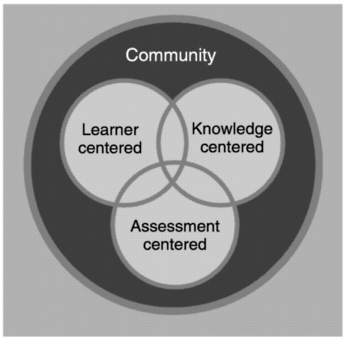
The readings this week shifted away from literacy though, and began discussing the development of formative assessment. I think that there are still parallels there though. Bradford states early on that “learning theory does not provide a simple recipe for designing effective learning environments,” which I feel speaks to the issues of developing effective formative assessments and our failings to properly address information literacy (Bradford, 131). Yet, the explanations of how to create good learning environments and the visual of how these learning environments work together were extremely helpful. The ability to develop community-centered learning environments that are leaner-centered, knowledge-centered, and assessment-centered seems like the way to provide valuable teaching. Though, I did wonder about classrooms that may not be homogenous in the way of cultural norms. As I read how all of these elements aligned to create successful learning environments, I thought of large areas, like New York City, where school populations are extremely diverse in many areas, and, therefore the cultural and social norms in the classroom may vary widely. How do these types of classrooms affect the ability to build community learning environments that account for the diversity of the students in these areas?Figure 6.1, Blog 5

I really appreciated the slightly different approach that Greenstein took to the same tool. While it is also stated that formative assessment is student focused, instructionally informative, and outcome based, aligning with Bradford, a discussion about how this may look in the classroom provided a different perspective. Specifically, the importance that Greenstein places on transparency really spoke to me, as it seemed to pull students more directly into the discussion about their education. This idea of inclusion indicated that transparency with students about outcomes that directly related to their education helped keep them involved and understand their expectations. I feel like if these types of discussions had been had throughout my schooling, I may have been able to have more understanding about how my education would have been more applicable to life in the real world.

Blog Post 4: Reflection on Week 3’s Class and Week 4’s Readings

I really appreciated the approach that was taken in highlighting some of our screencasts, as seeing how other people approached the assignment made it easier to think of other ways that I could have done things. Being able to comment and discuss these approaches allowed me to ponder how I may approach future projects that may involve some of the same skills needed here. From comments made throughout this discussion and conversations I had with individual students, it was also nice to realize that there were portions of the project that everyone struggled with, although those varied from person-to-person. I really liked the rounds of discussion that followed regarding the readings. I think that having small groups helped our ideas to be heard a little bit more, as some people are not as comfortable talking in large groups,  and,  by coming together at the end, we could see the culmination of our discussions and how they fit into our own thoughts about the reading.

I think the Stanford History Education Group document was the most interesting of the readings this week, due to the approach they took to the study. I found that I had also held some of the misconceptions about student engagement with online material as many of the authors and teachers seemed to indicate throughout the study. Here we saw some of the same language that came up in our larger discussion, such as a need to “vet the information” that people encounter. The study’s definition of “civic online reasoning” was helpful as well. As with our larger discussion, “literacy” just doesn’t seem to be the right word, but this suggests a cognitive process to consider the information that students are being hammered with constantly.

Marchi’s article took a similar approach, looking at how teenagers placed themselves in the information world. I found it interesting how these participants filtered the information they ended up looking into further. The information that this study revealed though left me thoughtful about how students place themselves in the world at large. Though, I also considered that some of these questions were raised due to the authors and the wording that they used. For example, the study states that most teenagers believed that news was important to make decisions. Yet, due to the ambiguity of this statement, or lack of clarity directly following it, it was hard to tell if this was being taken as that teenagers felt that adults should be informed by traditional understandings of news to make decisions, as they did not see themselves needing to be informed in the same way, or if these were thoughts that reflected the participants’ approach to finding information in the news sources discussed throughout the study. I also found it interesting how the term “fake news” has really changed in meaning in the years since this article was written, as I would not have made the connection to the sources of information Marchi was discussing if it had not been defined in the article.

The remaining readings did focus on literacy, but I think each approach was unique and worth considering in a way to provide well-rounded understandings of how students should interact with information. The News Literacy Project tied back to the Stanford study and Marchi article and approached the idea of literacy in a way that I had not considered. Though, as I read this after all the other documents, it struck me as odd after reading Marchi. If students are extremely skeptical about journalistic objectivity, how do journalists break through that skepticism when addressing a classroom? It does seem like an interesting approach though, and the rather quick development with journalists willing to work with classrooms and students introduces this idea of communities coming together to be better informed.

I feel that this idea of community development is the crux of the C3 Social Studies Standards as well. Understanding that learning standards shouldn’t just prepare students to continue their education, these standards explicitly address the idea of citizenship and how this can build better communities. I think one of the ways this document addresses the idea of community building well is its reference to collaborative work. Postulating that group efforts are welcome and productive, students that work collaboratively and can engage well with information develop the ability to discuss and build their communities on informed matters. The Common Core State Standards for English Language Arts builds on these ideas by introducing literacy standards, but allowing for the idea of content standards to drive the main points that social studies should articulate in the school setting.


Marshall University Special Collections Screencast

Having a vested interest in my alma mater and their ability to help students get the information they need, I chose to create a screencast to introduce students to the Special Collections at the university that often goes unnoticed, due to library services being focused elsewhere. Aware that most library services are introduced in a required freshman course known as UNI, this screencast provides a scenario that could be familiar to many students. To keep the content focused, the topic focuses on an integral part of Marshall Univeristy history that every son and daughter of Marshall has been introduced to since 1970.

Below you will find the screencast and the transcript:

Marshall University Special Collections


Hello, I’m Kate, a proud daughter of Marshall, and today I’m going to show you Marshall University’s Special Collections website which you can get to by going to marshall.edu/special-collections. Marshall’s Special Collections is home to the university’s archives and numerous West Virginia specific materials that students across campus have access to. To help you connect a little better with what you might use this website for, I’m going to walk us through a scenario of how the site could be used to show you some of the key features Special Collections provides you

So, say you are in your UNI class and the professor is introducing you to the library services offered at the university. It’s closing in on November, so to help you connect with the present day and our community’s history, an assignment is provided where you are asked to find a primary source about Marshall in in the 1970s. All you really know about this time period is the movie that had Matthew McConaughey in it, but you have heard about the upcoming fountain ceremony and think it’d be interesting to maybe learn a little more about the actual event.

On the website, we see a list of popular links down the left hand side and promoted information by Special Collections in the center of the page. By clicking on Search Our Collections, we are given a few options, including access to the online database, a list of university archives, and a link to digitized photos and images. While the university archives could be promising, they are not digital, but if you want to check out the library, our Special Collections staff would love to help you.

We reach our best online option by clicking on the database link. From the movie, you remember the name Red Dawson, so you start there. This search gives a photo, and clicking on this provides information down the right hand side. If Red isn’t the end result that you’re looking for, you can always use the search terms underneath the photo for related links. If you were to click on the Marshall University plane crash link, for example, results would appear related to that integral part of Marshall History that you could browse, fulfilling the assignment and teaching you about the community’s history.

Marshall University, Special Collections, and numerous sons and daughters of Marshall help maintain these materials as a way to keep memories like our beloved 75 alive.

Blog Post 3: Reflection on Class 2 and Week 3 Readings

I think the discussion we had regarding the differences between empty and appropriate praise raised some interesting ideas and really helped hammer the understanding down, for me at least, about how to approach progress with others. It was relieving once we got into this discussion a little bit that our misunderstandings about this particular issue and the abstractness it still seems to have is not just an issue for me. I think that applies for all of our discussion that focused around distinctions that can hold different meanings for different people, like the conversation we also held about the novice and the expert. This particular line of inquiry and discussion made it easier to understand the ACRL Framework on another level, which I had not looked at as thoroughly in the experience I have had with the Framework in the recent past.

The Mackey/Jacobson reading regarding metaliteracy was extremely hard for me. I think this stemmed from my previous experience with so many types of literacy being used interchangeably with one another. As Mackey and Jacobson are trying to make these forms of literacy distinct, as to show that information literacy is insufficient but metaliteracy is a workable framework, I think I let myself get bogged down by the intricacies of all the different types of literacies being discussed. I think the biggest take-away from this was that metaliteracy FRAMES information literacy to allow for connections across various types of literacies. Of course, the idea of frames speaks to the authors’ contributions to the ACRL Framework and the move away from learning objectives that so many groups seem to be doing in the recent past.

While I have some prior experience with both the AASL Standards Framework and the ACRL Framework, I wanted to focus on taking something from both of them that I had not previously done. For the AASL, I had spent so much time critically looking at the visual representations that I completely overlooked that it too was a framework. While I still have some very strong opinions about the visual representations, a closer look at the table provided did give me less of a visceral response this time. This time I was capable of seeing how, box-by-box, this table could be extremely helpful, though I believe its presentation in the table is cumbersome and hard to digest as a whole. The ACRL Framework really emphasizes this idea of collaboration, even after the discussion of collaborative work that is explicit for the frames themselves. This issue of collaboration has steered much of the conversation about the framework in the profession in the practical implementation of the framework in reality, but I had completely missed the discussion of this expectation that was laid out in the appendices in my other instances with the framework.

I thought the Obama proclamation was interesting as well, mostly because I did not know there was an Information Literacy Awareness Month. The comments made in the short proclamation truly make sense though. This call for awareness is essential to the adaptation of the ever-changing information world, where people are constantly being hammered with information they are expected to process. This evaluation of information has become an even greater focus as available information is monitored less and less. On top of the usual suspects of literacy, deciphering information is becoming even more paramount.

Blog Post 2: Reflection on Class 1 and Week 2 Readings

Introductions from class and the course overview have once again made me extremely excited for the future of this course and our professor. While many of the faces are familiar and I appreciate their thoughts and ideas on various subjects, I am also excited to get to know more about the new faces as well. Personality and interest rich, I think this course will provide a very unique learning experience due to the positions of all the people involved in the class. Some of the course work does seem intimidating at this point, but I am confident that it will be approached in an understandable way and that student collaborations on particularly tough tasks will be a hallmark, just as the last course I took with her was.

The One-Shot Workshop (Veldof, 2006) introduced the ADDIE approach, which seems to be the development approach this course will be taking. With the brief, concise overview of the approach, I can understand why it has been adopted. As I read, each step made sense, but the authors were also sure to be real about the situations that librarians face in the real world. The acknowledgement of group formation and the problems that sometimes result was very helpful. While I know that these issues occur in group projects, it is often not addressed when discussed in this context.

Bowels-Terry et. al (2010) addressed the idea of best practices for online video tutorials. This research could be seen as the A, I, and E of the ADDIE approach, as it was analyzing the target audience, implementing the tutorials, and evaluating their effectiveness and findability. The results of these findings then could be used to better the design and development of future tutorial implementation. It seems that the skills addressed in these tutorials (basic library navigation skills) may be where these types of learning experiences may be the most effective, as the authors and their participants are wary of using such techniques for more complex content. Some of the accessibility concerns that were addressed by participants included accessibility to videos off-campus and the usability of videos by non-native English speakers. These issues were addressed by suggesting the use of providing information in multiple formats, speaking slowly, and giving videos captions.

Flynn (2013) discussed the idea of providing screencasts that allowed learners to determine their own experience. By allowing for a “Choose Your Own Adventure” approach to Screencasting, it is suggested that learners will get more out of them and that they will be used in their entirety. This reading emphasized the need for correct design and development which requires proper analysis. Implementing these ideas in proper planning of execution allowed for use and Evaluation was discussed in the features offered by the YouTube informatics provided for the videos being discussed. This article also seems to hint that Screencasting may be most effective for databases, websites, or tasks that are difficult to navigate or have confounding instructions, but may be less effective for tasks and skills that are easily determined due to layout or other existing instructions on completion. Accessibility, of course, comes in the way of technology. Screencasting to explain skills or tasks for a target audience that doesn’t frequent videos or the Internet could be problematic, as would be a target audience of a lower means which may not have reliable access to such technology. Screencasting for the audience that Flynn is addressing, though, seems to have no problem with accessibility, and this type of approach was extremely successful for the objective.

The final reading provided some tips to make a good screencast which seems to be applicable to all kinds of online tutorials. These tips also seemed to address the ideas of Design and Development that ADDIE suggests. In all the readings, it made the first task seem less daunting and even doable, even before I have decided on a focus. They made me excited to find something to work on to implement these ideas in a way that will be beneficial to me.

Introduction (643)

I’m Kaitlyn Haines, but I go by Kate, and I’m from Fairmont, West Virginia. I spent the last six years in Huntington, West Virginia at Marshall University getting two bachelor’s and a master’s degree. I work with an organization called the International Women’s Baseball Center selling merchandise to raise money to build a museum and education center, which I hope to run one day. I am a huge sports fan, especially baseball, soccer and hockey. I also enjoy comic books, movies, and learning about sharks. Learning new things and taking on new challenges fuels my motivation, and, often, my inspiration.

I often am searching for new ways to engage my mind, whether it be in the form of cinema or puzzles. These interests have led me to become a collector in the recent years of my life. On a normal day, you can walk into my apartment to find a puzzle laid across my dining table with a movie playing in the background as I work on yet another task. I am a proud animal lover and owner who loves her rescues. I have a passion for cooking and learning about all kinds of foods.

I have always been an adventurer, and take every chance I get to go somewhere new. In every new place I go, if I can, I try to find a locally owned restaurant for a meal and a brew, because I truly believe that food reveals everything you need to know about a place or a person. I often joke that most of my friendships are based around food, and I feel that this is true for that reason. A true West Virginia girl, nature adventures often turn out to be my favorite, as I love the outdoors, hiking, climbing, and fresh air whenever I get the chance.