Mini Trainings at NTK

    While called training, these interactions were almost weekly occurrences where members of the staff shared their intercultural experiences in the library and academic worlds to gain a better understanding of the world at large and the major issues facing libraries today. This opportunity was a great way to get to know each other a little better and to provide a fuller understanding of our experiences. This was a time of discussing “assignments” and interacting with our staff members, but it was also a time of relaxation in a way too. To me, it was more like a targeted cultural exchange, a time to be able to talk about our experiences with a decently narrow focus.


    The class work was hosted by a moodle course, but often, our in class time was pretty freeform, with a topic guiding our discussion. To orient everyone, we started with the history of NTK and Czech libraries and quickly moved into the territory of Carnegie libraries. These led to discussions about the academic worlds of both the Czech Republic and the United States as well. The U.S. approach to education, in fact, became a topic in several interactions with people throughout my time in Prague.


    For the middle part of our time in these trainings, we tackled hot issues in the library world, from discovery issues to “solutions” introduced by corporate arms. We would talk about issues that staff had in providing reference help to patrons due to discovery issues one week and then, the next, announcements from groups like Kopernio would dominate our discussion. We even fell into the headache producing topic of journal negotiations and the paywall that still confuses and fascinates me, as it has been a more pertinent topic since my return as well. Before moving into the final portion of our trainings, we discussed reference models and how those appear in real life as well.
IMG_4986
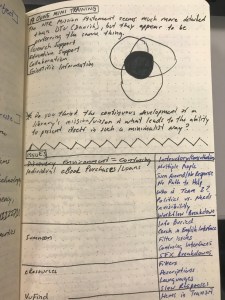
Notes from one of our trainings, with a chart discussing staff issues with discovery.

    The final portion of these trainings focused on our experiences though. While several of the people involved were regular staff, the interns had their own unique experiences in libraries that my mentor wanted us to share. We spent some of our time presenting on these experiences. I really enjoyed learning about my Turkish colleagues’ experiences, as that is a culture I am still learning things about, and I liked being able to talk about my path to Prague as well. (I created a short presentation that you can view here, if you want to see it).


    This type of facilitated interaction was extremely helpful to me and helped to provide a global perspective on library issues that I think I have truly lost in being educated in the United States. The downfall of many U.S. programs, I feel, is this lack of global connection that so many students look for. It is actually something I have challenged in several of the programs I have been a part of in the past. These mini trainings were capable of bridging some of that gap though, and my continued interactions with my colleagues, I feel, slowly closes this gap as well.

Moodle Course-Reference Resources

    Moodle is an open source course tool that NTK utilizes in its learning experiences. Whether it is a course on scientific writing or a training course for staff, Moodle is used to organize courses, much like commercial options like Blackboard or Canvas. This is a tool that I saw used in a few of the courses I sat in on and it was used in the mini trainings our staff took part in each week. It was also the platform for one of my final projects at NTK.


    Having worked with the Reference Source section of the CRM Platform development, Alena approached me in my final week in Prague about a possible Moodle course development. As I “tied up” each of my projects, she felt that this was final project was a way to help the entire staff in later trainings. As support services are not always trained reference professionals, being able to explain reference resources to students can be a challenge. Even as a trained reference professional, the number of resources available in a library like NTK can also be overwhelming.


    I was tasked with creating a learning tool to help guide NTK staff in choosing appropriate reference sources in their interactions with patrons. Without much time to develop it, my task was mostly to create a “skeleton” of what such a tool would be, and then implement parts of it into Moodle so that it could grow and change with the library.

IMG_3855
Working on the Moodle creation.

    This gave me the experience of creating a course without actually having to implement it, and it was a fun experience to learn how the tool worked and be aware that platforms exist beyond the commercial structure that function much in the same way as the ones institutions pay so much money for.


    I took the basics from the form I had developed for the CRM platform and used that structure to create the structure for the Moodle Course. This broke down the NTK’s reference sources into about 8 different types of resources. These were each defined and explained how they may be used in reference meetings with patrons. Then, for each of these categories, each resource that fit into the category was broken down as follows:

  • Availability
  • Content Covered
  • Volume Available


    By giving the basics of each of these resources and defining the types of resources they were, it was hoped that these could be used to develop an “arsenal” for staff to use in interactions with patrons. This tool, hopefully, would also be used as a reference resource for staff when confronted with questions that went beyond this tool kit they had created for themselves. I believe it was Alena’s intention to introduce this tool in trainings with staff so that it could help them provide better services to NTK’s patrons.


Some of my original notes are available for viewing here so one can see the idea of the course’s breakdown.

English Conversations

    Have you ever had an hour of freeform conversation? It is definitely an interesting experience. We went from dorm living (Czechia vs. U.S.) to history to comic books and their convoluted universes. It was interesting to learn that most people here only know Batman, Superman, and Spiderman. Next week SHOULD be more structured, or, in the very least, have a specific topic (Personal Log, 21 May 2018).


    The following week was not more structured, and picking topics just seemed too ingenuine. Often our meetings just consisted of discussions comparing our experiences. The excerpt above came from my first day at work, where I met with 3 post doctorates who I would meet with on and off throughout the summer. They had been meeting with my mentor prior to this to practice their conversational English, and Stephanie thought it would be a good way for me to meet new people. By the end of my first week, I had 3 regular conversation groups set up, ranging from 3-5 people each. In most of them, the groups knew one another, but there were a few people that didn’t.

Conversation 1
After a conversation at the food truck.

    It was definitely an experience I hadn’t had before and it was one of my favorite parts of each week. We couldn’t always meet, and sometimes we would combine groups so it wasn’t just one-on-one, but I know I particularly enjoyed the time, and I hope that each of the people in the groups got something out of it as well. I think one of the most interesting things is that there were no topics off limits. Honestly, one of the most entertaining meetings I had was an hour discussing why water closets are called restrooms or bathrooms in the United States.


    These were also some of the times I felt the most comfortable in Prague, and so I felt I was taking too much advantage of a situation where English was the dominant language of the situation. While it was my working language, even sitting in the office I was often surrounded by discussions in Czech. While this was completely expected, I fell into a particular type of comfort talking in my native tongue about really nothing at all. This made me fear that I was speaking too much in many of these instances.

Conversation 2
After a conversation at the coffee shop.

    One of these occasions was most likely due to the groups getting used to one another, especially the group that was composed of people that didn’t really know one another. It also occurred when I had a few sit downs with a group of interns working this summer. Though, in that situation, as I answered questions they asked me, I would be careful to ask them to answer them in return. This was much later on in the summer, though, so maybe I was conscious of overspeaking.


    Overall, the weekly English conversations were some of my favorite times each week. It was a way to relax during the work day, and we often spent the time in the coffee shop located in the library or a food truck just a few blocks away. The experience actually made me even more interested in learning the language so I could possibly have similar experiences while conversing in Czech at some point.

Jewish Escape Networks Talk

    One of the reasons I feel that I fit in so well in the academic world, whether it be in research or in the world of libraries, is my consistent thirst for knowledge and to learn the unknown. This general curiosity usually fuels my travels as well, and was something that was cultivated well by my mentor this summer in Prague. Early in my internship, Stephanie even went so far as to send me toward a history talk in the city. This led to my first real exploration around Prague Castle, getting lost around the castle, and listening to a fascinating discussion on Jewish Escape Networks in Prague during World War II.


    Stephanie, my mentor, knew of my background in history and my interest in learning more about how the Czech Republic fit into the overall narrative. She also was aware of my interest in World War II history, as we had discussed my previous research focus in school (the All American Girls Professional Baseball League, which played throughout World War II in the United States) and my experience in other countries around the Czech Republic where I continued to study World War II from the Eastern Front (Ukraine and Poland). Therefore, when she learned of this talk, she sent me on my way, with a comment that she would join me if she hadn’t had some things she needed to finish at the library.

IMG_4908
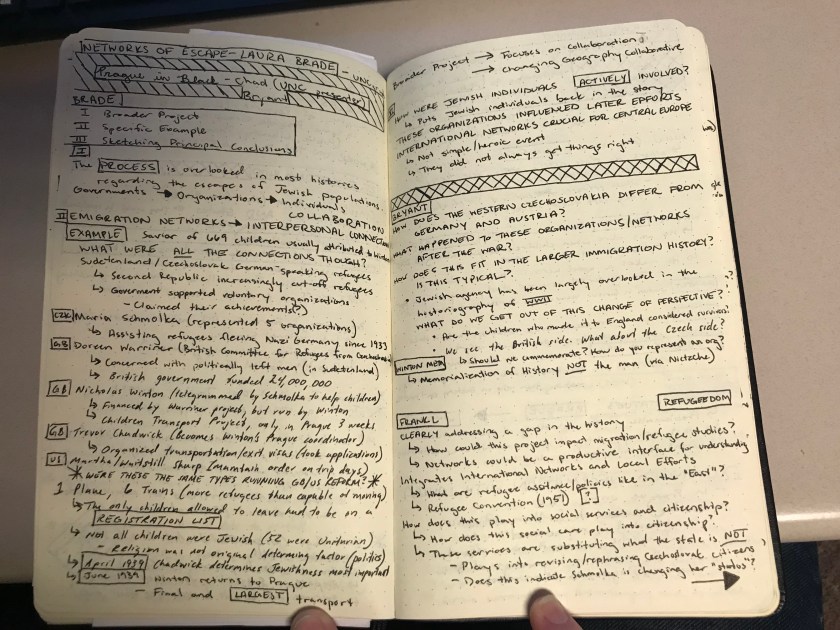
Notes on the Entire Talk.

    This talk led to my introduction to the historian Laura Brade, a recent graduate of the University of North Carolina-Chapel Hill and a faculty member at Albion College in Michigan. Her research had led her to spend time working in Prague and exploring how the Jewish population worked in the Czech Republic once they fell under Nazi rule in 1939. With the knowledge that Prague itself lost approximately 97% of its Jewish population during the war years, this talk was engaging, heart wrenching, and amazing all at the same time.


    The talk led me to names I had not known before, including the story of a Czech woman I wish we had learned about during my studies of World War II history: Maria Schmolka. She had a hand in helping refugees flee Germany since the Nazis came to power in 1933. Brade talked about these stories and emphasized how these networks were created through a collaboration of emmigration networks already established and interpersonal relationships. She went on to talk about how this process is often overlooked in most histories, which I personally agreed with having known very little about such networks beyond small initiatives by individuals. One of the things I found incredibly refreshing, though, was her discussion on how heroes and heroines such as Schmolka, a Czech native, is often overlooked by the concerted efforts of more prominent organizations and religious groups, such as the American and British groups that worked in the area at the time. She talked of these “good will” missions which often would not have been possible without the efforts of people like Schmolka, who are often lost to history.

IMG_4909
Notes from Brade’s Response to Moderators and Audience Questions

    I found the entire talk extremely engaging and I have noticed that it has colored some of my readings into the subject since this time. Even as an academic, I have always found myself a little hesitant to engage with others about their talks though. I did make an effort to talk with Dr. Brade after her presentation though. After a long discussion with questions I had about her work, we had hoped to see each other again before she left the country, but this did not work out. Still, I looked up her other work in the field and have definitely kept an eye open for other works in this field. In fact, I kept these very ideas in mind when I recently read Eichmann in Jerusalem: A Report on the Banality of Evil by Hannah Arendt, who addressed these types of networks throughout her book.

Librarian Club of Dresden’s Tour of NTK

    One important aspect of anyone interested in Library Management is being able to communicate about your institution with people, especially stakeholders. In smaller libraries, you are often responsible for communicating with far more than just stakeholders though, and knowing your library is crucial. Still, you need to be able to talk from experience. My mentor, Stephanie, gave me the chance to put these types of skills to the test late in my time at NTK.

IMG_4905 (1)
Notes about the upcoming tour.

    A large group from the Librarian Club of Dresden visited NTK for a tour late in July to tour the facility during a short visit to Prague. With 60 people in the group, it was too large to be tackled by just one person, so my mentor asked if I’d be interested in leading about half of them on my own tour. This allowed for two groups to tour the facility at the same time, and the librarians were capable of deciding to hear the tour in English or in German (a language my mentor is fluent in).

IMG_4906 (1)
My “script” to consult throughout the tour.

    Like many people, I am not always comfortable speaking to a crowd and I wasn’t overly confident in my knowledge about the library, even two months after beginning work, but I agreed, thinking that this opportunity was going to be helpful for me later in life. Another member of the support staff, Olga, joined me in support, but Stephanie left me to my own devices to make the tour my own. She provided me with a sample tour but encouraged me to make it my own, which allowed me to talk on the projects I had been working on throughout the summer. She also provided a fact sheet about the library for each of the Dresden librarians in German.

Talking
Talking to the Librarians. (Photo Credit to Lori Haines)

    The logistics of the tours was addressed in a short meeting those involved had just a few days before the tour. With two tours going at the same time, we had to discuss how we would move the groups throughout the building and not cause too much disturbance to our patrons. It was agreed that Stephanie would do an introduction to the entire group in German and then let them split into groups. Then, my group would make our way to the top floor and work our way down, while her group worked their way up. Wanting to finish in the Atrium (on the second floor), I had to figure out how to include the first floor offerings as well. In this meeting, I addressed a few clarifications that I wanted, such as to ensure I knew which of the floors in the library were silent and what not.


    On the day of the tour, along with the librarians from Dresden, my family also joined us, as they were in town visiting at the time. We made our way to the library early that morning and they followed the tour as went along.

Presenting
In the Instructional Room, addressing the group. (Photo Credit to Lori Haines)

    After Stephanie’s introduction, our groups split up. I made a few clarifications about how we would take the tour upstairs with some brief comments about the first floor. Noting that the top floor of the library is a silent floor, we allowed time for everyone to make it upstairs and look around before moving to the fifth floor, where we could speak more openly. I made the decision to fully walk around the fifth and the fourth floor to give us more time to talk about what the library offered. When we made our way to the third floor, another silent floor, we went to an instructional room to speak briefly before we made our way through our office spaces, past our periodical room, and down into the atrium. The atrium allowed me to make my final comments, make a few more mentions of the first floor, and inform the librarians about exiting procedures from the library.

Video
My brother engaging with NTK’s video game kiosks after the tour. (Photo Credit to Lori Haines)

    By ending in the Atrium, the group was given access to a unique offering at NTK, the freestanding video game kiosks, and were provided relaxed seating so they could wait on others or engage. During this time, I was capable of talking with some of the librarians about my experiences and we waited for the other group. Once the other group joined us, I was capable of speaking with a few of them as well.


    While it was an overwhelming experience, I learned a lot about communicating effectively and learned a lot about the library. This was also helpful in preparing me to discuss the projects I worked on upon my return to the United States, a requirement for some of the funding I received for the opportunity.

Learning Czech

    For anyone who knows me, language is a difficult thing for me, as it is for many people, especially with the subpar approach to language learning in the United States. Even while I enthusiastically attempted to learn Spanish through junior high and high school, it was just not something I picked up, unlike my brothers in their learning experiences. Still, language is an integral part of understanding anyone’s culture, and the topic fascinates me to this day.

img_4880
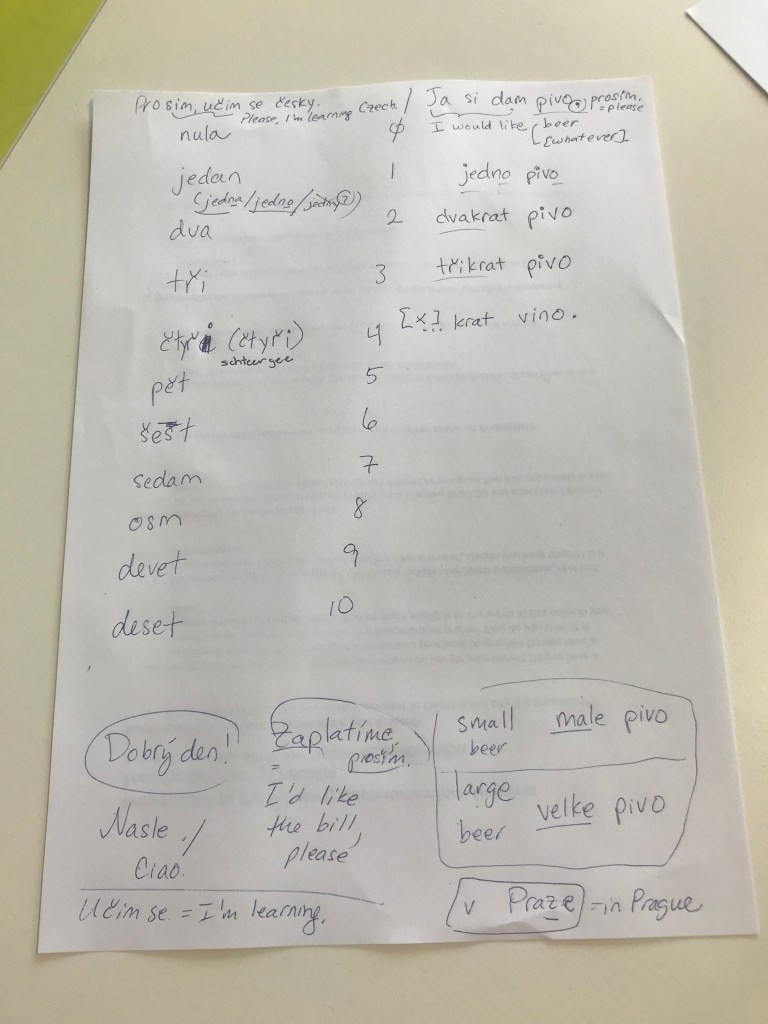
Just a few jotted down phrases and words from the beginning of the summer.

    While knowing Czech is not required by any means to be in Prague, I wanted to actively try and learn at least a little bit. As a tourist there for a few days, I would have at least attempted to learn a few phrases like hello (dobrý den) or thank you (děkuju), but living there for almost three months is a completely different story. I was working, living, and functioning much like anyone in the city. I had interactions with the staff in my building and throughout daily activities, like going to the grocery store, that, while English was something I could use, I felt like I could at least try to learn enough Czech for these situations.

img_2841
Learning how to count and the most basic ordering tips.

    My office was composed of a diverse group of people from several nationalities, so while I heard Czech daily, our “business language” was English. My building manager and the staff that worked in the dorm and shops around where I was living, on the other hand, didn’t speak any English. Those were some of my most difficult interactions throughout my stay in the country. If you want to leave Prague, knowing a little Czech can also be helpful, such as getting stuck in a train station in Benešov, though thankfully I had a colleague with me for that one.

img_4881
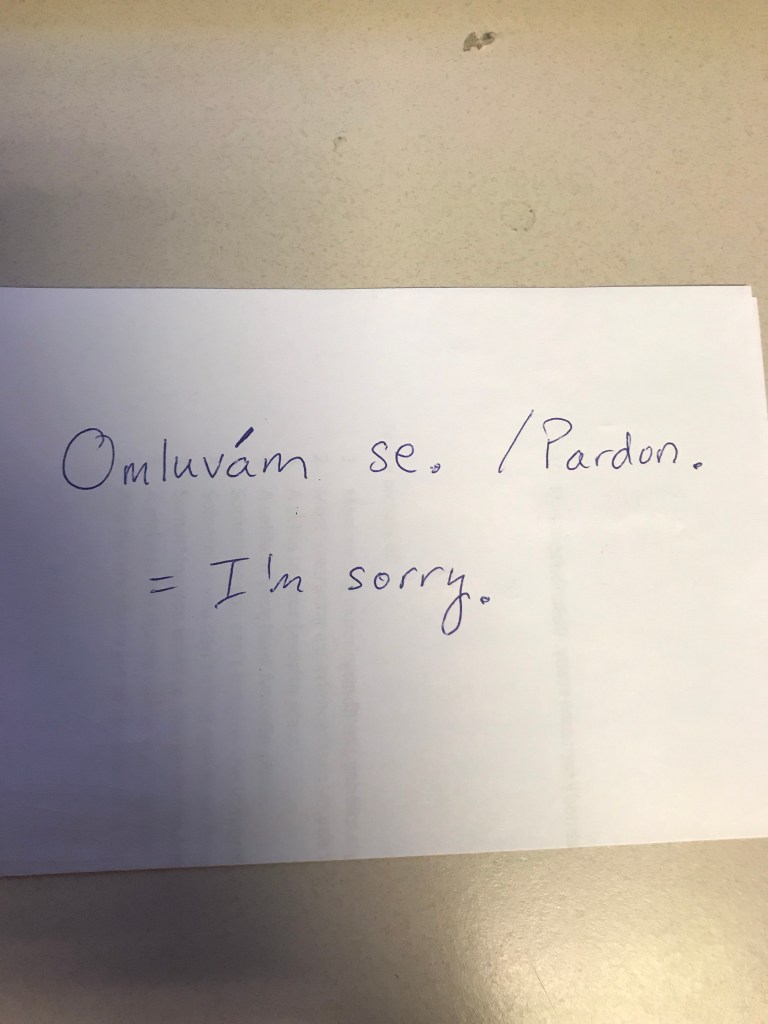
Like many European countries, Czechia borrows some common words from other languages. “Pardon” and “Ciao” are heard often on the streets.

    With all of this in mind, I set a goal for myself: Before I left Prague, I wanted to be able to make it through simple interactions at restaurants and markets strictly in Czech. It started small, with my mentor just jotting down some helpful phrases and making sure I understood how to pronounce them, but I was capable of picking up a few things. My approach was crude to say the least, but by the mid-way point, I made it through most of my restaurant interactions strictly in Czech. I never fully mastered the market interaction, but I could make it through most of those without speaking at all.

    Having fallen in love with so many things about the Czech Republic, upon my return to the United States, I enrolled in a Czech language course that I thoroughly enjoyed last semester. I’m still not completely satisfied with my skills and actually holding conversations in Czech makes me extremely nervous, but I have come much further in this language than the Spanish I studied on and off for seven years. While I am no longer enrolled in a structured course (due to scheduling issues), I am also continuing down the path of learning more. I have textbooks, flashcards, online resources, and, of course, most important, those colleagues still in Prague. I hope when I return (hopefully this summer), I’ll be able to test what I’ve learned and surprise even myself.

CRM Project

    Another summer long project I participated in began before I came to Prague. In an attempt to better gather data to serve patrons, NTK has taken up a project to create something that resembles a Customer Relations Management (CRM) Platform. I worked in the Services Division of the library while I was there, and one of the services provided to patrons is consultation services, from basic reference inquiries to assistance with research and writing. Up to this point, this data has been tracked through forms and a spreadsheet, but the hopes of this project is to streamline this and make data gathering and service tailoring easier for the staff. This was the main focus of the project with hopes of expanding beyond this in the future to make the platform more viable for the Services Division and possibly the library at large.

    I worked with Alena, Alexey, and Marine on this project and each of us had specified tasks. As Alena managed the project, Alexey was our platform creator, working with open source software and customizing it, while I worked on a particular portion of the form and helped Marine and Alena in user testing. Due to the lack of patrons in the summer months, full testing of the project was not capable of beginning in the summer, but developments in the project were possible.

img_4877
Notes on CRM project and notes about the interface.

    Specifically, I was focused on incorporating the plethora of resources available to patrons into a digestible way for the form. With more than 50 databases, physical collections, and special services available to patrons, this became a daunting task in the beginning. In the end, I decided grouping these resources in like ways would be helpful and this idea was adopted after a general discussion with the group, a mock-up, and satisfactory user testing. Tracking resources used in these types of consultations could lead to more informed decisions about resource utilization for library staff in the future.

    Another discussion that we had regarded the versatility of the interface. I worked mostly from a tablet while in Prague, and upon accessing the interface from here, Alexey attempted to incorporate some of the ways it functioned into the desktop interface as well.

img_4878
Notes from CRM meetings and thoughts regarding interface and resources.

    These types of discussions in our meetings often led us to having new versions of the interface to interact with when we met. Near the end of my time in Prague, we began user testing with the staff because of the success of this iterative process. All of our testing was done in the division, as it is a tool meant for the staff there, and was done on a paper version of the interface, as the computer version was not quite ready for testing yet. The feedback we got from our 8 test cases was extremely helpful, indicating we were moving in the right direction and that some changes should be utilized.

    While it was hoped that this project would be launched in October with the new semester, development is still in process with the hopes of implementation occurring soon (according to my colleagues in Prague). The interface has continued to change as the iterative process of the project has led to more understanding of how the platform can operate. A backlog of consultations and accounts has been added to the platform, which was used as a test case to understanding how the analytics could be utilized while also providing base data for the project. This will continue to be an ongoing project and there are hopes to expand to include actions such as tracking courses, lectures, workshops, excursions, queries, and meetings.


Space Use Project

    One of the most important things about creating assessment tools in library settings is to show the value of library services and to make more informed decisions as the library continues to function. The idea of the Space Use project I worked on with colleagues Martin and Alena was to make more informed decisions about the space of the library, but it was also intended to provide useful statistics in whatever capacity they could be used in.

    NTK is a large library that caters to a wide variety of patrons, so understanding how the space is used is crucial for the library to maintain its value. The development of this project began in the summer because there are fewer patrons at this time and it allowed for ample time to develop and test the methodology that we used. Keeping in mind the sheer size of the building, we decided to start small and build the project as we discovered what did and did not work. We began our development on floor four of the library and tested and developed our methodology until we were satisfied. This took us several weeks, but we were relatively satisfied with the mock-up we had created. As we went, we also developed a workflow to standardize this project, as other staff would be responsible for implementing it after we were gone (I left in August, prior to the new semester, and Martin was also leaving the division soon).

floor 3 4
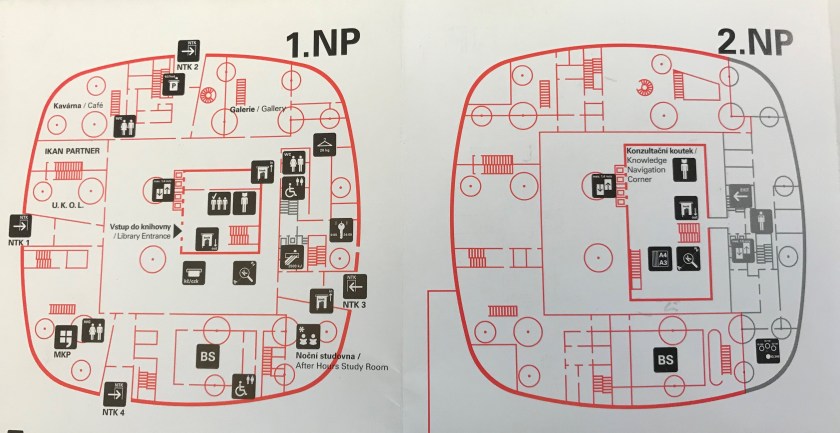
Image taken from the National Library of Technology’s “NTK Guide”.

    In our planning of this project, our coordinator, Alena, advised the reading of Gullickson and Meyer’s “Collecting Space Use Data” (2016)* and Martin suggested several web-based techniques to determine our preliminary approach. Beyond this, we used their expertise of the facility itself and my previous experience as a space use observer (which was one of my responsibilities as a student assistant at my university library in the United States).

floor 1 2
Image taken from the National Library of Technology’s “NTK Guide”.

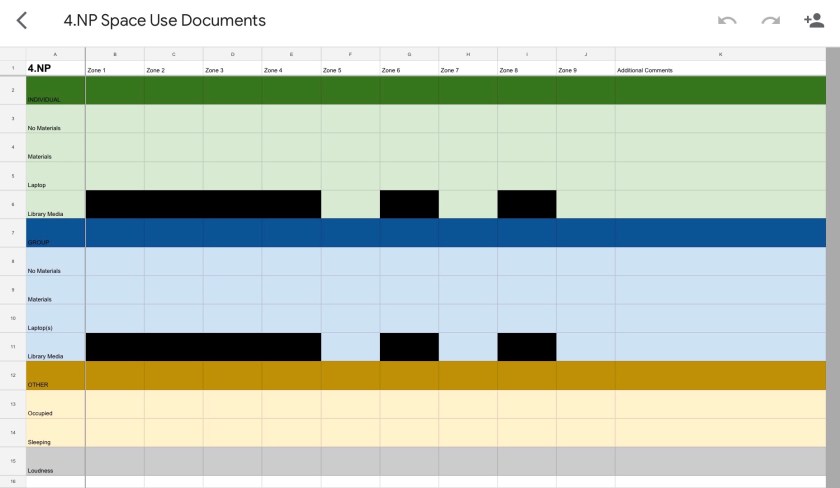
    Our original goal with the project was to develop floor plans, a time plan, and determine activities to be observed throughout the project. We wanted to begin with a general approach that could become more specific over time, as routines were developed and patterns began to emerge. One of our problems was that much of the furniture on the floors in movable, so we decided to “zone” each floor into like spaces (such as study tables or relaxing areas). Without a programming background among us, we developed spread sheets for our observations, data entry, and analysis with the hopes of digitizing the process in the future. (It is my understanding that this process has now been started since I left the city).

img_0683
From the files on the project, this is what my final edition of the fourth floor spread sheet was.

    Several issues were discussed as we tested our project. Should we count occupied seats that did not have people in them? To determine the community engagement of the users, should we use anecdotal observations? Could we incorporate the “gate counts” that were already recorded at the library? As these questions were answered, the project expanded to the third floor as well. With varying layouts, more spreadsheets had to be created to capture all of the data. By the time I left, each of the floors had been prepared for implementation when the students returned for the next semester. We finished my portion of the project by testing the standardization of the process, training other interns to carry out the observations before we ceased observing for the summer.

    The last I checked in on the project, it had not been implemented, but an updated timeline had been introduced. They had found someone to create a database for them to store their data for easier recording and analysis, and it was hoped that when the next school semester starts, observations will begin.

floor 5 6
Image taken from the National Library of Technology’s “NTK Guide”.
*Gullikson, Shelley and Meyer, Kristin. “Collecting Space Use Data to Improve the UX of Library Space.” Michigan Publishing vol. 1, no. 5 (2016).
**Images from the notebook are from my personal notes on my time in Prague.


Saying Goodbye to Prague

38850844_10211612324415662_5230000359446937600_n.jpg

    My final days in Prague were even more difficult that my final days at work. Work had at least provided me the comfort of other people and tasks to focus on. Once I left on Friday, my only task was to pack and prepare for my return. I think it may have actually been easier to have departed on Saturday to return, but that is something to keep in mind for my next extended stay outside of the country.

38765894_10211612317735495_1405323280755195904_n

    Friday evening I did laundry and focused on getting everything together that weren’t clothes, to hopefully make the packing process easier. This was when I also decided what I would not be bringing back with me, to save on space. Saturday continued this trend, as I spent the day in my dorm doing more laundry and packing everything. I ended both these evenings watching films in my dorm and staying close to Strahov. My heavy heart on leaving this place I had been so attached to this summer made it difficult to convince myself to leave.

38842039_10211612319735545_5421846524105588736_n

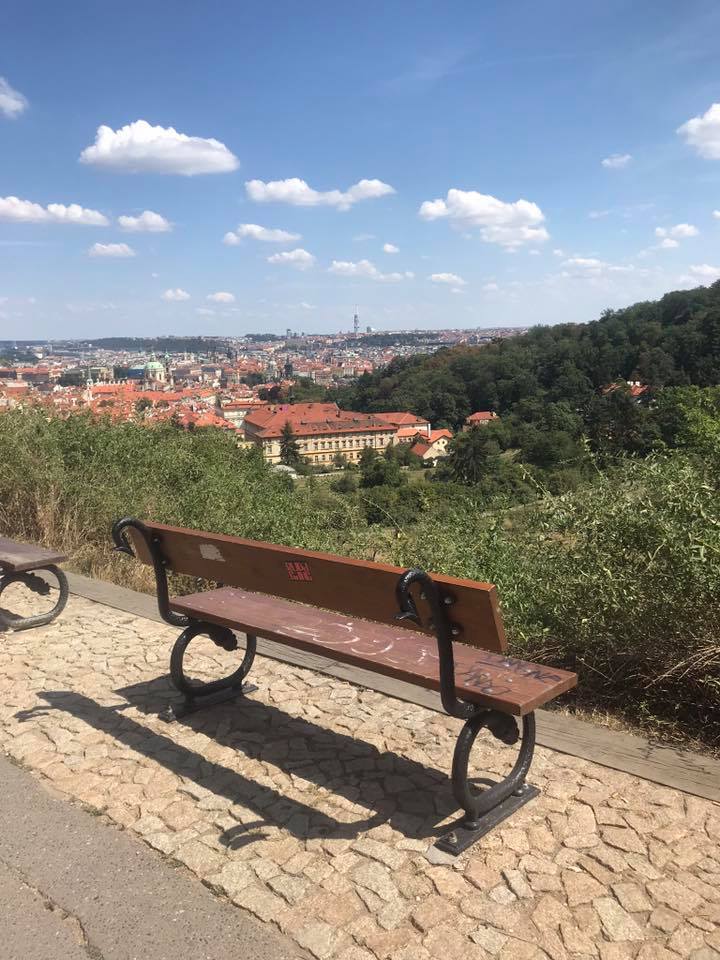
    Sunday, I had to get some fresh air though. While I had accomplished everything in the city that I wanted to, I knew I had to see it one last time before I left. I took the very familiar path to Petřin and took one last walk through the park taking in the place of it all. Upon recommendation of a colleague, I did set out to find Ferdinand beer, a brew I had not come across in my time in the city. I ate at Restaurant Ferdinanda, near Prague Castle, and took my time, taking in everything, before I decided to make the climb back up to the castle and Strahov Monastery, where I finally tried their blueberry beer.

38879497_10211612317575491_8618915137232830464_n

    I spent the day slowly taking in the city one last time, enjoying the place I had spent the summer, and reminding myself that I would return sometime in the future to take it all in again. I ended the evening reading in my dorm, fully packed and ready to travel the 16 hours back home the following day. As is often the case before I travel, I did not sleep well that evening, and was ready to leave around 6am.

38861771_10211612318615517_8383261744969023488_n

    I did hit a few snags returning my keys, ID, and bedding at the dorms, but I finished my checkout from Strahov around 7am and made my way to the airport, by bus. Of course, I arrived extremely early, as I am known to do, so I had to wait to check my bags and again to go through security. My flight to Philadelphia ran pretty much on time, and I was only delayed slightly for my trip back into Miami, though I did hit some snags in getting my luggage at my final destination. All-in-all, the return home ran smoothly, and the final days in Miami before returning to Ann Arbor were full of family and laughter. It is the coming weeks, as I catch up from being gone all summer and work on preparing for the coming semester that things will get hectic again.

38878066_10211612326655718_5902636587832836096_n

    There is one great thing I must always keep in mind though: the end of a journey just means you are that much closer to your next adventure.

Final Week at NTK

    The last of something you quite enjoy is always extremely bittersweet. The time I had in the Czech Republic was beautiful, rejuvenating, and worthwhile in so many ways, but the end was always set in time. As time closed in on my last days, I had a strong want to remain where I was, despite the fact that I had so much waiting for me back in the U.S. With the possibility of my final year of university coming up, I also did not want to return to that possible ending. I suppose when you’ve been in school for almost 20 years, the thought of what comes after is quite terrifying. Still, my last week was full of excitement and work, like the rest of my time in Prague.

38935445_10211613398522514_4982013736664432640_n

    Monday and Tuesday led to the end of my weekly conversation classes and the introduction of a small project for my final week at NTK. I truly hope each person I got to meet with in those meetings feels like they got something out of it, I know that I did sitting and just chatting with them, even if it was only an hour a week.The laughter and camaraderie of a freeform discussion can have such positive effects.

38902127_10211613399162530_6818596474612350976_n

    Tuesday led to our final mini training, which meant a presentation about my path to 38765868_10211613402282608_309655098953302016_nNTK and the internship that I held this summer. It was also the first of many times I was almost brought to tears by my colleagues in my final days. In our usual warm up for the course, the entire group went around saying something they learned or liked about me. Talk about emotional, and then I had to present, which is not something I’m ever comfortable doing. I discussed my path to the University of Michigan and the internship at NTK and then about the library system in Michigan that I work in, which were many of the themes we have had in these trainings as we all try to learn from the experiences of our international colleagues.

38802543_10211613400562565_7688905656513855488_n

    I spent most of Wednesday and Thursday on the small project I had been tasked with at the beginning of the week, getting my things in order, and making sure the projects I was leaving were where they needed to be and all information was with someone else. The small project was to set up a better resource for our consultation staff to use when recommending reference resources to our patrons. I created the skeleton and examples for the project and then met with fellow interns on Friday to pass it off for continuation.

38810203_10211613398122504_3431100672416677888_n

    Friday was my final day at NTK, which meant I got a late start and ran most of the day leading up to my farewell party. Still, my last day was full of drinks, fun, and laughter. I was gifted a lovely notebook from my colleagues with pictures and sentiments from my time in Europe this summer. I then provided my own gift, hopefully starting a type of “Intern Survival Kit” for the interns that remain and those that come after me. I thought of this as a way to connect more and make each subsequent interns’ lives a little easier. By providing a small token from your time at NTK that would have made some aspect of your stay easier, we build a way to make the next intern’s experience better, or, at least, that is my hope. I gifted a sušak, or a dryer, which would have made organizing my laundry days much easier on me. I also provided a small notebook so we could share these stories with those who come after us. It is my hope to return to Prague one day, and, hopefully, new stories and items will await me from across the world of the interns that have been capable of working at NTK.