
Konopiste is a castle from the fourteenth century located approximately 40km from Prague. It’s most well-known resident (at least in world history standards) was Archduke Franz Ferdinand. Originally a hunting castle, the estate was purchased by Ferdinand after his cousin Rudolph visited it, knowing it would suit the man. Now, Konopiste is a beautiful estate run by the state, which contains the castle, it’s surrounding gardens, the “pond,” and a rose garden. The property came into possession of the state after Ferdinand’s assassination in 1914, but was used for various purposes throughout both world wars and the communist eras before it was turned into an historical site and restored.
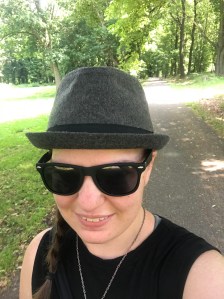
Today, you can visit Konopiste by taking a train to Benesov and walking the approximate 2km to the castle (through the very scenic route of its gardens). It is a destination of many in the Czech Republic due to their connection to Ferdinand’s wife, Duchess Sofia (who was a Czech woman). While the tours are a tad expensive, there are four offered, and the information and views are worth every koruna. There is no photography allowed inside the castle, so getting glimpses at the Archduke’s life requires the fee. On any day you can visit the North or South Salons (two separate tours), the private flat of Franz Ferdinand, or go on a hunting tour. There is even a range that can be used on the property.

Traveling with my cultural attaché and the Turkish interns that joined us this week, we got a deeper look into the lives of the Archduke’s family by taking a tour of his flat. In my time in the Czech Republic, I have become fascinated with this man because of the information I have learned regarding his place in history, but the new information acquired here just piqued my interest more. Actually, my time at Konopiste made me question even more why the only this we know about Archduke Franz Ferdinand is that his assassination started World War I. While this is clearly true and is by far the reason world history finds him important, the complexity of this man is often lost. In fact, it took me coming to the Czech Republic to even learn that he was not the only one that died the day he was assassinated. His wife, Sofia, was also killed that day, orphaning their 3 children. You can actually view the dress she was wearing that day on the tour (at least Tour 3, of the private flat).

While you get a brief introduction to his political and military life, the focus of the tour is on his private life. The walls of the castle are lined with his trophies, which indicate the importance of him choosing a hunting castle to reside in. Ferdinand made his first animal kill at the age of 8 and was an avid hunter until his death at age 50, killing some 275,000 animals all over the world. Each trophy is carefully marked in his home with the date and the place, but some get more distinctions, like the number of the kill or who was with him. Some of these trophies are actually from his family (such as one that was his daughter’s from age 3).

Still, the more private areas of the estate are quite homey. The children’s playroom is covered in Sofia’s art (the daughter and oldest of the siblings). There are books and model boats (which the boys were quite fond of). In the study, there is even a portrait of Emperor Franz Josef I as a young man. What struck me at that was that I don’t think I’ve ever seen the man depicted as young. All other pictures I have ever seen were from near the end of his rule, when he was at least in his eighties.

Like many stories about the Czech people, the story of Franz Ferdinand and his family is tragic. While they were quite happy at Konopiste, from what can be determined, this was also a place of sanctuary for them. Ferdinand’s marriage to Sofia was never fully accepted. She was a countess when he began courting her and Franz Josef disapproved the first time he asked for her hand, but he did not give up. A year later, he approached the emperor again and received permission to marry her. This raised her status to Duchess, which still placed her below the status of the Archduke. As a stipulation of their marriage, Ferdinand and Sofia also had to renounce their children’s right to the throne, which is what led Charles to become emperor after Ferdinand’s assassination and the death of Josef.

The death of Ferdinand marked the beginning of some very tragic ends for his family. Sofia travelled with Ferdinand for his trip to Sarajevo after leaving their children from a short holiday. In the attempt to kill both the next heir to the throne and his right-hand man in the military, the conspirators failed. While they were successful in taking out Ferdinand, they missed his general and killed his wife. This orphaned their three children (Sofia, the oldest, still a teenager). They would leave Konopiste for a castle owned by Sofia’s family (the Hohenbergs), where they would be cared for by their teacher and Ferdinand’s step mother. They survived the war, but WWII would not be so kind. While Sofia married a German man, her brothers were not so lucky in their position. Late in the war, they ended up in concentration camps that they did not survive. Sofia lived until her eighties and her daughter is still alive today (and in contact with the caretaker of Konopiste).

The chance to learn more about the family and story of Archduke Franz Ferdinand was quite fascinating. While there we also walked down to the “pond,” though I’m not quite sure how anyone could categorize it as such, and spent some time in the rose garden, where we were acquainted with several peacocks. As is the luck of the weather, we spent the last bit of our time at Konopiste trying to outrun a storm. We did not succeed, but a little rain never hurt anybody. The problem is that the brief, strong storm caused damage to the train tracks leading back to Prague. We spent about three hours at the station before we decided to find a new way back (as this type of delay is extremely unusual in this part of the world). Our group ended up with an Uber back to the city, which was definitely an interesting experience, but it did allow us to see some of the villages just outside of Prague, which I really liked. Making it back much later than anticipated, it was nice to make it back to my dorm for some much needed sleep.


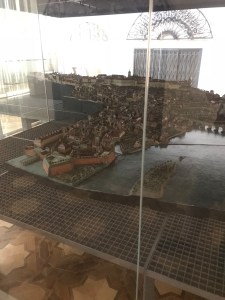
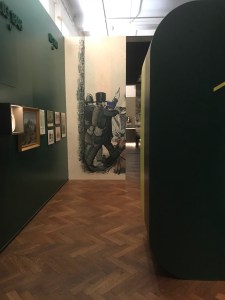
 that was a bit of a lie, because it was about 31 degrees (almost 90 for those that don’t know Celsius conversions) and the walk from Strahov to the museum is about 5km. I did enjoy wandering the streets of Prague though, as I always do, and I was quite impressed with the museum. I went for the “1848-1918” exhibition that I had been seeing advertised around the city, but I spent several hours taking in all of the exhibits. It was definitely a nice experience to see some of the artifacts and the Prague model, though I was definitely partial to the exhibit I went for. While I have been spending time reading about the history here, it was nice to get more specifics about the area, and to even recognize some things from my time in the city and my reading while I’ve been here.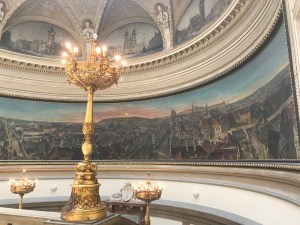




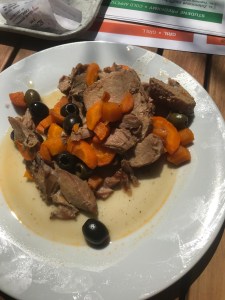
 Saturday was a day at the zoo and then an evening spent at Prague Castle. I had some great conversations about the history of the castle and other places I have visited in the Czech Republic while also discussing my experience of culture and work here. We ended the evening at one of the pubs below the castle before retiring to their apartment for more card games.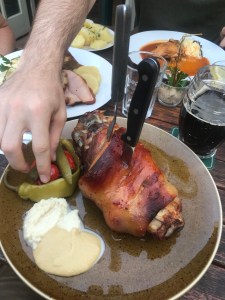
 morning slow but made our way to the other castle in the city by early afternoon. We took in the views and some of the attractions (like the Gothic Cellars) before making our way across town for the match. The pub I chose was packed, but we made our way to the back room of the basement to find a spot to watch the match. On our way back to the apartment that evening, we stopped for gelato, but called an early night due to my need to return to work on Monday for a brief time.
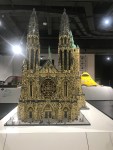 Monday started at NTK, where I gave a tour to a group of librarians from Dresden (which will be discussed more in next week’s blog) before spending the last full day in Prague with my family. They joined the Dresden librarians for a tour before I took them for pizza and off to enjoy our day. We started near Mustek, where we spent some time at Hamley’s (mostly for the Czech RepuBrick display) before heading toward Old Town through the Powder Tower and past the Black Madonna Building. By the time we made it to Old Town Hall, we were got in a thunderstorm, so we stopped for desert before deciding to head back to the apartment and wait out the storm.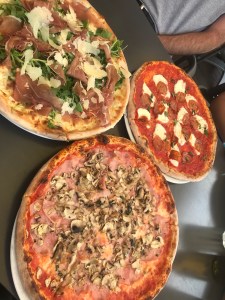
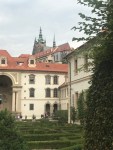 apartment for jackets. I then took them up to Strahov, to show them the stadium and the place I have been staying. With the hopes of feeding them, I took them down through Petrin to see the gardens and observation tower before making our way back toward the castle. We stopped in the mirror maze, which I feel needs renamed, as it is no maze at all, and arrived to the square outside the castle a bit too late to find food. This led to a trip back near the apartment, where we found a small place to eat before we said good night to one another.
 Tuesday morning I met them for breakfast, where we tried Cafe Savoy together, before I bid them farewell. I set off to return to work while they returned to pack and continue their trip, as they flew to Rome that afternoon. It was a long and grueling weekend full of laughs and plenty of food. There were a few hiccups, but all-in-all, it was a pretty typical family visit with an out-of-country twist.

 some of these cultural readings. With a basic understanding of the Czech Republic’s past (Austro-Hungarian Empire through the fall of communism), this week I spent most of my office hours learning about contemporary politics here in this country. On top of the information that I have been receiving about the United States’s current political climate, I have been able to remain much more engaged than I thought I would. The connections and the need to understand how these events play out have played into enthusiasm for a type of history and understanding I often overlook.
 here. My personal belief is that anyone that will spend any amount of time in a country should learn at least a little bit of the language, even if the people speak a common language, as it shows a respect to the people you are among. The thing is, as difficult as the Czech language is and as small of a population in the world that actually speaks the language, I want to continue my education upon my return to the United States. I sat down with my mentor, who is still learning the language as well, this week and she gave me some great resources and suggestions to continue my education. On top of that, I plan on keeping in contact with the colleagues I have here upon my return, so it’d be nice to be able to communicate with them in Czech in the future. Here’s to the dedication to learning a new skill!
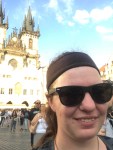 here than I ever have in my actual home. My own preference is to spend most of my time in solitude due to social anxiety that I experience, but this is not an issue I have had here. I expressed interest, when introduced to the library’s director, that I liked jazz music, and this week I got the opportunity to attend the Bohemia Jazz Festival, which was quite lovely. I couldn’t stay long or attend both days, but it is something I would have definitely talked myself out of if I had still been in the United States. Wednesday I was invited to join two of my colleagues for lunch as well and invited for (how they ask to buy you something) ice cream. We enjoyed a lovely conversation about media representation (specifically strong, female characters in merchandise, like Gamora or Rey) and about the issues with plagiarism and intellectual property rights in and out of the Czech Republic.

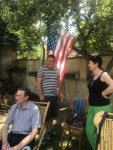 colleagues was celebrating his birthday. Of course, it was really only a half day for our department. We traveled to his residence as a group to attend a BBQ which lasted well into the night. There I met some people from the library I hadn’t gotten the chance to meet yet, including the director of NTK. The director was a lovely man and we had a great talk about jazz music, which led me to learning about a jazz festival going on in Prague early next week (hopefully I’ll get to attend and be able to report back). It was quite a nice way to spend this American holiday (our birthday boy brings out his U.S. flag for his birthday each year), as it was a group of great people, good food, and no fireworks.
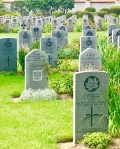 weekends recently (and trying to spend at least one day decompressing each week), I took this opportunity to explore some areas that I just haven’t had the chance to get to. After a short conversation about cemeteries with a colleague, she suggested going to the two in Praha 3 (a large cemetery in the city and the New Jewish Cemetery).
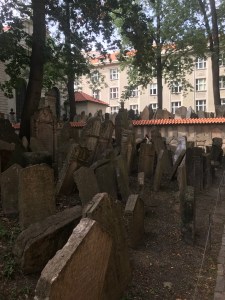
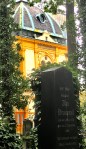
 Thursday I walked the larger cemetery, spending most of my day there, taking in the beauty, while Friday I did the same at New Jewish Cemetery. They were lovely days of reflection and pictures capturing the beauty.
 Of course, with the quarterfinals on Friday, I also found myself watching soccer. I even caught a couple Wimbledon matches, and found a few new coffee shops. The Croatia-Russia match on Saturday evening was definitely the most exciting I’ve attended so far. I went to the dorm bar to watch, as it has been a quiet place to watch the matches in the evening, to just end up sitting at the bar trying to see while the bartender and I
 got some good entertainment from the other fans. I have never seen more than 10 people in this space before, and this match filled the room (probably close to 75 people). It was quite amazing.
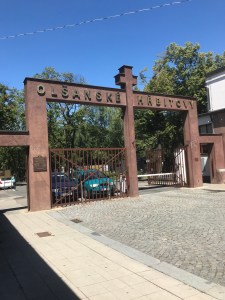
 There are a couple places that have piqued my interest while I walk home, so I decided to go exploring. It really just led to a nice, long walk, but it’s nice to know more of what it around. I know my explorations next week will be much more organized, as my family will be in town and I’ll be showing them around.






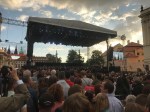 project this week (as we are now expanding to include more of the library), my time was also split among discussions with colleagues about other approaches to issues in the library and the conversations that I am hosting with students. Interesting opportunities, like seeing the Czech Philharmonic at a free open air concert, presented themselves, along with instances I didn’t expect to encounter in Prague, like a bomb threat at the campus in which NTK is located.

 to do so in recent weeks, especially with our cultural excursions. This week I read mostly on the Czech experience of communism and the Velvet Revolution, which I have found extremely fascinating. There were other readings on the early twentieth century and some more recent political things, but the major years in recent Czech history (1948, 1968, and 1989) were the focus. These were the political markings following WWII, when the Czech government went communist (1948), when the Czech Republic was occupied (1968), and when independence was won (1989). A colleague actually provided a book of photography that showed snapshots of 1948 and 1968 which were extremely interesting.
 due to a threat on the campus in which it sits. Colleagues went to a cafe nearby to await news and I learned that I may have been the only one in my department that has ever experienced a bomb threat. Following the cafe, we went to a restaurant for lunch, where many of us stayed for several hours, before we parted to enjoy our unexpected day off. I went to explore that day in a new part of the city, where I watched the Sweden-Mexico World Cup match.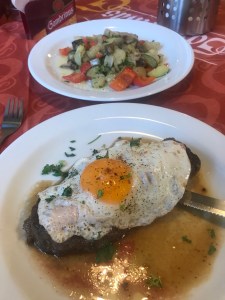

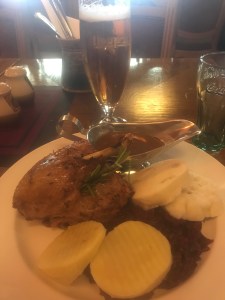
 Bridge area from my dorm. There I watched the England-Panama match over some lovely food. I made the trek back up to my dorm, but decided to sit out the other two matches, getting some rest before the week ahead. I watched a movie and did some reading before getting ready for the week of work ahead.
 Raven K