

(Title comes from Raganathan’s The Five Laws of Library Science page 351.)
The Fourth Law of Library Science is “SAVE THE TIME OF THE READER” (Raganathan, 337). As in the previous laws, Raganathan, again, repeats the law and its meaning throughout the chapter. A shift away from books and the reader to focus on the situation within the library itself, an increase in these iterations is prominent. The repetition of law and idea appear approximately 1.7 times per page. Some form of “SAVE THE TIME OF THE READER” shows up 29 times throughout the chapter. Raganathan also explicitly states the Fourth Law 48 times. With only 45 pages to cover this topic, a 0.2 increase of times on the page is interesting, but the content does not lack because of it.
The focus of this chapter can be summed up into the awareness of time economy. In other words, Raganathan focuses on what libraries can do to save the time of their patrons, as time becomes a commodity that many people are unwilling to give up. To do this, he goes back through several aspects of the library that he has already discussed to divulge in the problems that may be faced in optimizing the time a patron spends at each task. A good portion of this chapter looks at the issues addressed by the Third Law from the perspective of the library instead of the patron. From the importance of open access stacks to the library staff’s duties, Raganathan focuses most of the chapter on the in-library experience of the patron. To conclude the chapter, he removes the patron from the library and briefly discusses location, stating that the Fourth Law should be considered in the placement of libraries as well, as to not take up too much time of a reader in their travel to and from the institution.
With time efficiency being the focus of the chapter, Raganathan provided examples for his in-library aspects by explaining a patron’s possible experience in a library. He stated that open access systems were readily adopted in U.S. and English libraries due to their time efficiency because closed stacks could lead to days of searching on the part of both the staff and the reader, which discouraged use. This same type of efficiency is considered in the arrangements of books on shelves. While he states that subject-matter is the best arrangement, the Fourth Law takes another step by stating that placement of subjects that are more popular in more accessible places is also an integral part of retaining readers. This type of arrangement is also why guides should be made available to make stacks more navigable, from maps near the entrance to clearly marked stacks and shelves.
Raganathan then removes the reader from his place in the stacks and addresses time constraints in the search of books themselves. This begins his shift from reader to staff. While he is clear to discuss the importance of time efficient adaptations for the reader in catalogues, bibliographies, and reference services, he shifts the focus from the reader to the staff’s place in these services as well. Understanding that books can address several topics, Raganathan champions the importance of cross-referencing in the catalogue, which, he believes, calls for highly trained staff to do this properly. With vast numbers of materials, like periodicals, Raganathan also suggests the investment in bibliographies, catalogues, and indexes to be essential, and for staff to be able to properly use them for reference and instruct readers on their use as well. The importance of staff and their ability to help readers is encapsulated in his comment that “slow, dull-witted, immobile and absent-minded persons cannot be of any service to the Fourth Law” (Raganathan, 362).
Following these discussions that involve both staff and readers, Raganathan spends most of the rest of the chapter on how saving the time of library staff saves the time of the reader. Most of this discussion can be summed up by the following: standardized library procedures to saves the time of staff and allows them to save the time of readers. With a brief description of changing charging and discharging systems, Raganathan concludes “perhaps it is only in the charging method that the ideal of the Fourth Law has been actually reached,” as he champions the newly established two-card system (Raganathan, 367). He goes on to state that areas of work in optimizing staff time in procedures to provide more time for readers and centralizing catalogue systems, in the long term, saves time and money.
Throughout the chapter, several concepts were introduced that I didn’t previously 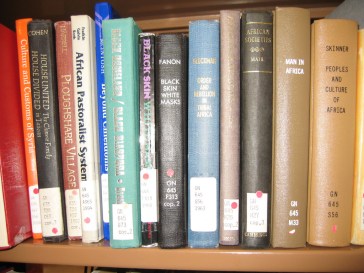 know about. In trying to learn more, I found it difficult to find a lot of information about these, and, therefore, went back to the book to try and get a better grasp on what I read. In a more focused search, I am sure that I would have found more specific information, but the evolutionary nature of libraries, I believe, may have clouded the general information I was getting back. Paste-down cataloguing (338), day-book and letter discharging (365), and two-card systems (366) were the specific examples I was looking

for. While some resources, albeit a little dated, were available, the brief descriptions Raganathan provided seemed more helpful. I did find it interesting that when Raganathan spoke on call number tags for books that he essentially “plugged” a particular type, specifically “Dennison’s white circular tags, number A-144,” as he stated they were the “most serviceable” (Raganathan, 349). While, in a search, it is difficult to find this historical call number tag, Dennison Manufacturing Company seems to be the producer, which combined in 1990 with a well-known company that still manufactures office supplies globally, and created Avery Dennison.
This chapter also lent itself to a fuller description of Raganathan’s experiences in his

own library, as the focus became more about the institution instead of the books and the readers. Several times Raganathan makes references to his time at the Madras University library. To start out, he states that Madras University adopted an open access system in 1928, just four years after he became head of the library, and three years after he returned from London. Then, in discussing the flaws of cataloguing systems, he references the 70,000 book collection at Madras and the 14 folio volume catalogue that goes with it through the paste-down method. These references and others allows the reader to see the progress Raganathan had made in his tenure as chief
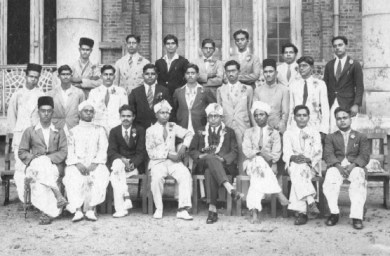
librarian and to better understand some of the steps that were later taken with the university’s library. In 1936, just a little more than a decade after Raganathan took over, Madras University would get a new library building. Just a year after this book was published, the first library course was taught at the university. Numerous other achievements in the library system were also accomplished before Raganathan left his post in 1944.

Images were taken from the following sources:
- http://www.isibang.ac.in/~library/portal/Pages/photo.htm
- https://hiveminer.com/User/odegaard%20library/Timeline
- https://www.framinghamhistory.org/exhibitions/dennison-timeline
- https://www.averydennison.com/en/home.html
Other helpful, and historical sources referenced:

 Raven K
It’s so interesting to hear a glimpse of the history of how libraries became what they are today. I never really thought about a system different then the one I’m used to (like the open stacks system). But hearing about how libraries’ stacks used to be closed off to users, it makes me rethink and see today’s library systems with a new pair of eyes. Do you know if Raganathan was the first one to think of the open access systems for stacks? Or if there were other libraries opening up their stacks during his time? That would be interesting to know!
LikeLike
It seems like the Fourth Law is a lot about what we today call User Experience. This was briefly mentioned in the User Experience Chapter of the textbook Information Services Today, but it becomes more apparent through your analysis. As I am becoming increasingly interested in the concept of User Experience both in library settings and outside of them, I find this historical analogue especially intriguing. User Experience is not just about being more efficient and time saving, but about creating a positive and useful experience all around. Certainly, having closed stacks and being confused about where to find what you need in a library would not constitute a positive user experience.
Your mention of Ranganathan’s concern with properly educating patrons on use of bibliography and other sources of information sounds like a reference to bibliographic instruction, which was a less encompassing antecedent to information literacy instruction. He was on the right track in asserting its importance in improving the ability of patrons to find the useful information they need.
LikeLike