

(Title comes from Ranganathan’s The Five Laws of Library Science page 414.)
The Fifth, and final, Law of Library Science is “A LIBRARY IS A LIVING ORGANISM” (Ranganathan, 382). This final chapter is a short 36 pages that provides the least amount of repetition from the rest of the book, with only allowing for an appearance of the law approximately 1.167 times per page. The Fifth Law is stated 36 times throughout the chapter, while its iteration only appears 6 times.
The final chapter opens with a brief description of what Ranganathan means by a living organism with quick connections from his definition to how it applies to libraries. He spends the chapter discussion two important aspects of a “growing organism:” size and evolution. The size portion of the chapter looks at the growth of books, readers, and staff in the library. The portion on evolution looks to the changing forms of what a library means as an institution and the numerous varieties it presents itself as.
When it comes to Size:
First, for a library to grow, its collection of books must go. To plan for such growth, the

idea of expansion must be ever-present. This is why the planning of buildings and possible expansion is crucial, but it has also led to the evolution of certain systems to better accommodate growth. This includes the introduction of ideas like stack towers and book repositories. The adoption of card systems, in cataloguing, issuing, and shelf-registering, is an explicit example of this. He concludes his discussion on books by highlighting the importance of adopting a tried and true classification system.
Second, for a library to grow, the number of readers it reaches must grow. The size of reading rooms, the issuing method, and safeguards must be considered when dealing with readers. It may be best for multiple reading rooms to be adopted, as to better accommodate large numbers of readers. Open access and the adoption of card issuing systems are the most adaptable to growth. The control of entering and exiting patrons can best safeguard against an uneconomical loss of materials. This postulation struck me as odd, due to its possible intimidating nature.
Finally, for a library to grow, its staff must grow. As the library grows and the staff expands (though, possibly not the staff visible to patrons), specialization and the development of clear-cut departments should be considered to optimize usefulness. From there, if the staff becomes large and robust, a staff council can be considered to help standardize procedures and increase internal communication. The continuity of work, especially by staff visible to patrons, should provide for staff to work seamlessly.
When it comes to Evolution:
Like the physical growth of an organism, all organisms must evolve and vary to continue their ability to survive. The modern library that Ranganathan has spent the entire volume describing is very different than the ancient library, which is emphasized especially in the discussion of the First Law and Second Law of Library Science. The importance of evolution in the library system allows for adaptability and variety in libraries to specialize in specific topics. While different types of libraries have common features, each variety of library has its own special issues. Library specializations, at the institution level, appear in many forms, but a few include the following: school libraries, university libraries, libraries for the blind, and business libraries (Ranganathan provides a more exhaustive, but still incomplete list in his chapter).
When it comes to the Vital Principle:
Ranganathan concludes his volume by stating that all libraries function on the same vital principle that can be understood if one understands the “spirit of the library” (Ranganathan, 415). This spirit is what has made the library capable of weathering the times, and this same spirit will help it continue to adapt in time. The vital principle this spirit resides under states the library “is an instrument of universal education, and assembles together and freely distributes all the tools of education and disseminates knowledge with their aid” (Ranganathan, 415).
Final Thoughts on the Volume:
In my reading, I noticed approximately half way through the book this idea of feminizing concepts. While I had been familiar with the use of feminine language when talking about object like ships and cars, I never really put much thought into the other things that are feminized at points. I was not too surprised when Ranganathan referred to Western Europe’s countries as India’s “western sisters,” but I did find myself puzzled that the laws were feminized (Ranganathan, 57). While Law I, IV, and V are never explicitly gendered, Law II and III are specifically referred to as women, in the discussions the laws have in their chapters. Along with them, the “Rule of Least Cost” and “Books are for Preservation,” both used in a dialogue with the First Law of Library Science, are also feminized. I had not realized the idea of feminizing this like transportation and countries (historically because men could “conquer” them and it fit in with the patriarchal society) could also be extended to concepts. These thoughts weighed on me throughout my time with the volume.
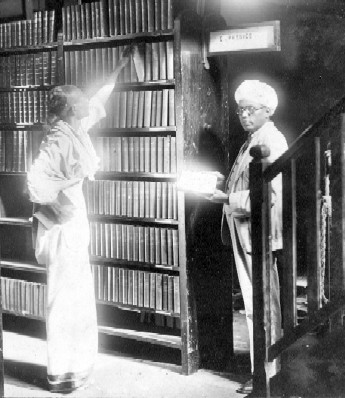
Concluding this 415 page manual on properly setting up libraries in India, there is only one single appendix. This may be due to the inclusion of tables, figures, and photographs throughout the volume, but I still found it odd. This 3 page appendix explicitly draws out the ideal stack shelf, from materials to dimensions. Drawing from the shelves that Ranganathan uses at Madras University, ten tips are provided to build the perfect stack shelf. If carried out to these specifications, a fully loaded shelf would weigh one ton and house 1,000 books in 84 feet of space. This ideal shelf, or at least the ones used in Madras, also use ten cubic feet of teakwood for each shelf.
Throughout the book, Ranganathan alludes to future books to cover topics in more specific detail. Here you can find a list of these books through GoodReads if you are interested in exploring his approach to library science in more depth: https://www.goodreads.com/author/list/566596.S_R_Ranganathan
Images were taken from the following places:
- https://arts.umich.edu/museums-cultural-attractions/buhr-remote-shelving-facility/
- http://www.isibang.ac.in/~library/portal/Pages/photo.htm


Wow you’ve really done a close reading of Ranganathan’s laws! That’s pretty epic. It seems like Ranganathan was thinking about the usability of space long before it was a popular thing to talk about! And with the staff must grow concept, does he ever go into what kind of recruitment goes into this? I think that would have been interesting to hear his thoughts on that! In Ranganathan’s world, what kind of person is the “ideal librarian”? Is it the same or similar to Dewey or Samuel S. Green?
LikeLike
You’re right that it is odd that he discusses controlling the entering and exiting patrons. This suggestion seems to be the antithesis of the openness and access to all readers he is trying to promote through the rest of the work. It’s almost as if his editor read the book and said, “you’re being to focused on openness; now add something to safeguard against damages.”
On the other hand, his use of the term “vital” is interesting and appropriate to what he postulates through the fifth law. His discussion of life and spirit goes hand in hand with the concept of the library as a living growing organism. I like this analogy very much.
Also that is is an interesting piece you note about the feminizing of some of the principles. In some ways I thought that could be a positive, but when you mention it in the historical context of being able to “conquer” feminized things, it feels icky!
LikeLike