

I think the discussion that followed the podcast on This American Life really brought to life the many discussions we have been having over information over the last few weeks. Having heard this particular podcast before and having listened to several this producer has created in the past, the class discussion made me think a little more in-depth about the “show” of these particular broadcasts. While I had recognized the notions of misinformation, despite a want to be well-informed, I had never made the connection of how this information gathering was portrayed by This American Life to the audience. I really appreciated the comments about how this broadcast was clear to point out that mistakes had been made, there was no effort to show how these mistakes could be avoided in the future, for either the listener or the subject of the podcast.
The parallels between this incident and this producer’s other major podcast “S*Town” were made very apparent as I listened and discussed the information issues at hand. Like Ben, the main subject of this series was also misinformed about issues he deemed extremely important. The difference here is that Ben was researching an action by local government and John thought that a murder was being covered up in his home town. The contrast in these two is that John was very well-informed about the world around him prior to the event that led him to reach out to This American Life, where Ben seems to indicate that his launch into politics and researching immigration were spurned by this particular event. These comparisons were very much at the forefront of my mind as we discussed literacy throughout the rest of class, and, it makes me consider listening through the other series again and seeing how I react to the information issues throughout it.
With the question “What do we do about it?” being posed late in discussion, it was a little disheartening that there doesn’t seem to be a good answer. How do we introduce children early enough to sort through what can be deemed credible information? Are the tactics we use to determine the credibility of information good enough? Are we possibly not doing a good enough job of making these decisions about credibility for ourselves? If we are coming up short in information literacy individually, how are we supposed to be preparing the next generation to sort through the plethora of information we are bombarded with daily?
The readings this week shifted away from literacy though, and began discussing the development of formative assessment. I think that there are still parallels there though. Bradford states early on that “learning theory does not provide a simple recipe for designing effective learning environments,” which I feel speaks to the issues of developing effective formative assessments and our failings to properly address information literacy (Bradford, 131). Yet, the explanations of how to create good learning environments and the visual of how these learning environments work together were extremely helpful. The ability to develop community-centered learning environments that are leaner-centered, knowledge-centered, and assessment-centered seems like the way to provide valuable teaching. Though, I did wonder about classrooms that may not be homogenous in the way of cultural norms. As I read how all of these elements aligned to create successful learning environments, I thought of large areas, like New York City, where school populations are extremely diverse in many areas, and, therefore the cultural and social norms in the classroom may vary widely. How do these types of classrooms affect the ability to build community learning environments that account for the diversity of the students in these areas?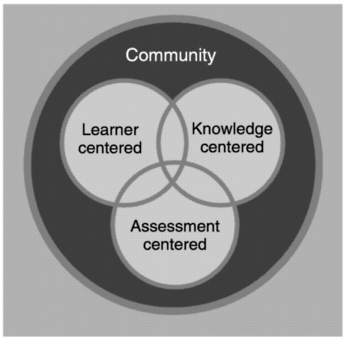
I really appreciated the slightly different approach that Greenstein took to the same tool. While it is also stated that formative assessment is student focused, instructionally informative, and outcome based, aligning with Bradford, a discussion about how this may look in the classroom provided a different perspective. Specifically, the importance that Greenstein places on transparency really spoke to me, as it seemed to pull students more directly into the discussion about their education. This idea of inclusion indicated that transparency with students about outcomes that directly related to their education helped keep them involved and understand their expectations. I feel like if these types of discussions had been had throughout my schooling, I may have been able to have more understanding about how my education would have been more applicable to life in the real world.

 Raven K
I absolutely agree about transparency and the need to involve students more as active agents of their own education. Anecdotally, between my own experiences and accounts of other students’ experiences in American primary and secondary schools, I think we are still a little stuck on schools teaching us “things we need to know”, rather than helping us learn “modes of thinking”. It seems that we’ve seen shifts toward the latter in recent years, but that we haven’t fully gotten there, and I think this is an especially important shift to make now, as external storage and recall of facts becomes easier and easier (see: ubiquitous internet, smartphones, etc.) and the task of analyzing, evaluating, and synthesizing those facts becomes more and more difficult.
LikeLiked by 1 person
I agree with your questioning of how are we supposed to handle misinformation and teach children how to tell if a source is credible. After thinking about our many discussion in class and through the blogs I started wondering why all of the responsibility is put on us, the reader? Fake or misinformed articles are posted all the time with no disclaimer that their information is satire or hasn’t been backed up with any evidence. Could a system be put in place that pressures news sources and online articles to verify their information and sources, show that proof, and be held accountable? This would be nearly impossible without infringing on free speech but it shouldn’t be all on the reader to decipher if something has any factual merit when their reading from a ‘credible source’.
LikeLiked by 1 person